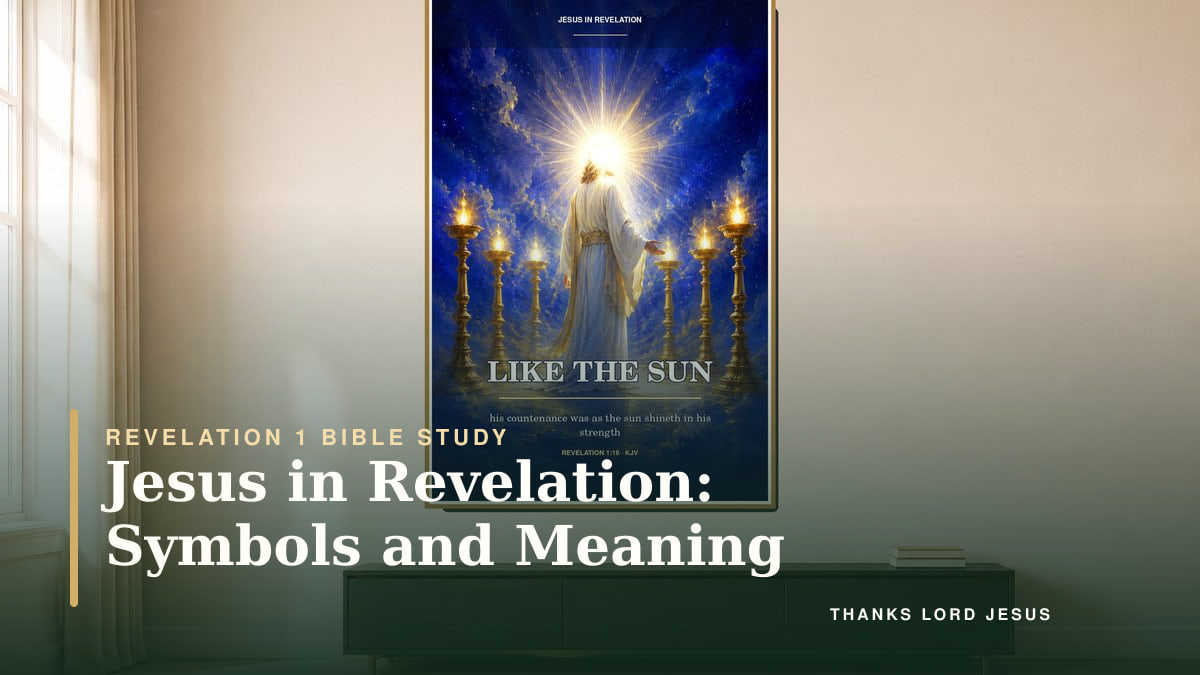
Revelation 1 presents Jesus as the risen Lord who is present with His churches, perfectly wise, searching in judgment, sovereign in speech, and alive for evermore.
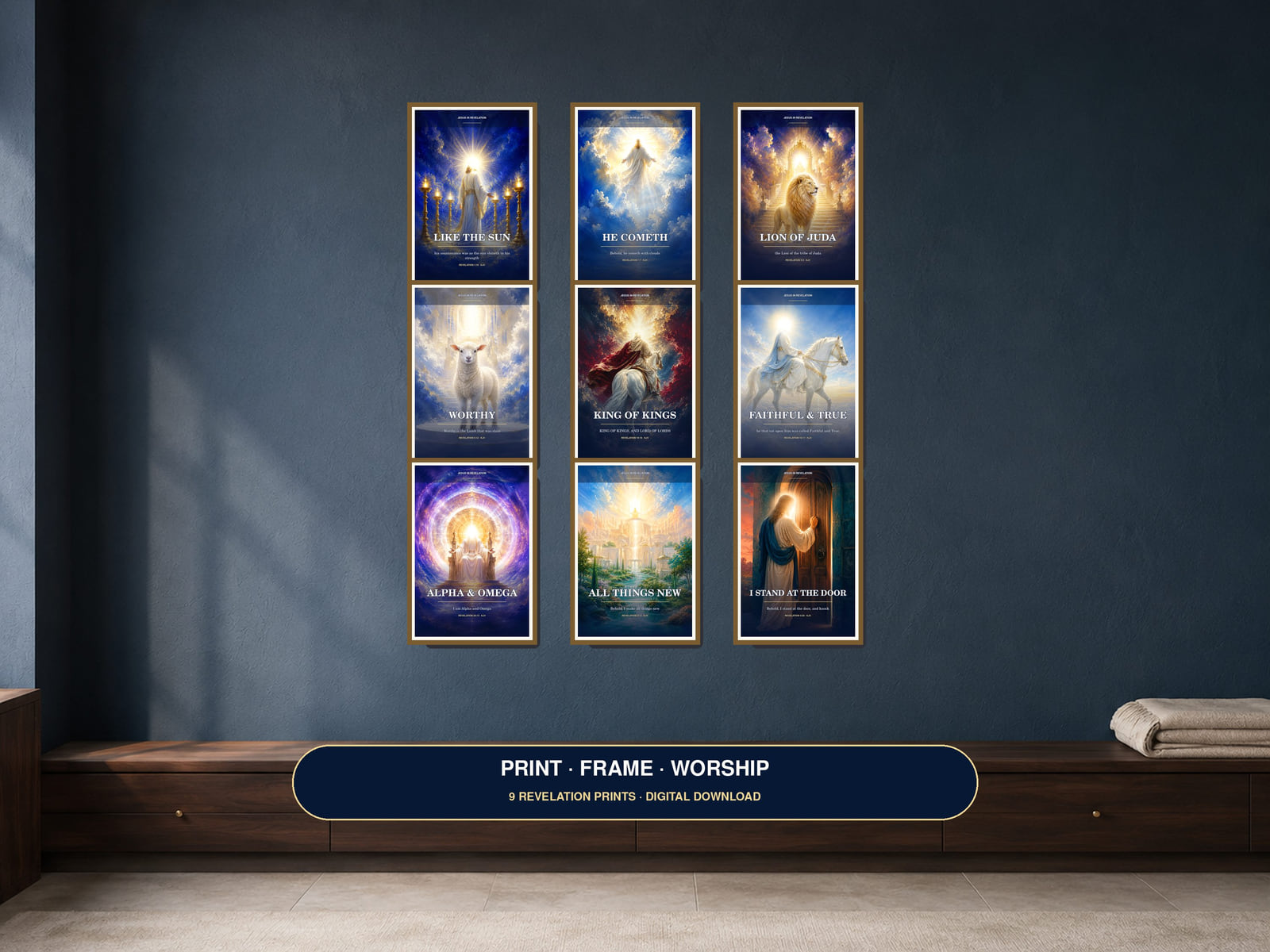
In Revelation 1, Jesus appears as the risen and glorified Lord: present among His churches, perfectly wise, piercing in judgment, authoritative in speech, sovereign over His servants, and victorious over death. John does not give a conventional physical portrait. He records an apocalyptic vision in which clothing, hair, eyes, feet, voice, stars, a sword, and overwhelming brightness reveal who Jesus is and how His churches should respond.
The vision is meant to produce worshipful confidence as well as holy fear. The One who tells John, “Fear not” is also the One before whom John falls “as dead” (Revelation 1:17, KJV). Jesus is not a distant symbol inside the vision. He is the living Christ who speaks, knows His people, corrects His churches, holds death’s keys, and promises the final renewal of all things.
Key takeaways
- Revelation 1 identifies Jesus as the Son of man, the First and the Last, and the Living One.
- The seven lampstands represent seven real churches; Christ stands among them rather than abandoning them.
- White hair, fiery eyes, bronze-like feet, many waters, stars, a sword, and sunlike glory communicate attributes and authority.
- The symbols should be interpreted from Scripture and the passage itself, not turned into a speculative code.
- John sees Christ’s countenance blazing “as the sun,” so obscuring facial detail with light is a reverent artistic choice, not a claim about Jesus’ ordinary earthly appearance.
- The vision calls Christians to listen, repent, endure, worship, and hope.
The setting of the vision: worship, exile, and a voice like a trumpet
John is on Patmos “for the word of God, and for the testimony of Jesus Christ” (Revelation 1:9, KJV). He is suffering, but he is not spiritually abandoned. On the Lord’s day he hears behind him “a great voice, as of a trumpet” (Revelation 1:10, KJV). The comparison signals clarity, command, and public authority. The voice commissions him to write to seven churches in Asia.
What the Revelation 1 symbols mean
The seven golden lampstands: Jesus among His churches
When John turns, he first sees seven golden candlesticks, or lampstands, and “in the midst” of them one like the Son of man (Revelation 1:12–13, KJV). Verse 20 supplies the interpretation: “the seven candlesticks which thou sawest are the seven churches.” This is one of Revelation’s clearest reminders to let the book explain its own images.
The lampstands are separate lights, but Christ is present among all seven. Their light is received and accountable; the churches do not create the gospel. In chapters 2–3, Jesus commends faithfulness, exposes hidden compromise, warns, and promises. His presence is comforting, but never tame. For the church today, the image encourages neither despair nor complacency. Jesus knows His congregations truthfully and remains Lord over them.
“One like unto the Son of man”: the promised King
The title reaches back to Daniel 7:13–14, where one like the Son of man receives an everlasting dominion. Jesus repeatedly used “Son of man” in the Gospels, joining His suffering mission with His future glory. In Revelation 1, the crucified and risen Jesus is revealed as the royal figure whose kingdom will not pass away.
His garment reaches to the foot, and a golden girdle crosses His chest (Revelation 1:13). Readers have associated this clothing with priestly or royal dignity. The safest conclusion is the central one: John sees no defeated prisoner. He sees the exalted Christ clothed with honor and ready to serve as judge, priest, and king in the unfolding book.
White hair: eternal wisdom and purity
“His head and his hairs were white like wool, as white as snow” (Revelation 1:14, KJV). Daniel 7 describes the Ancient of days with hair like pure wool. Revelation’s use of that imagery for Jesus is theologically weighty: the Son shares divine glory and exercises divine authority. The whiteness fits purity, wisdom, and majesty rather than human frailty.
Eyes like a flame of fire: searching, holy judgment
John says Christ’s eyes were “as a flame of fire” (Revelation 1:14, KJV). In the messages to the churches, these eyes belong to the One who knows works, love, service, faith, patience, compromise, and secret corruption (see Revelation 2:18–23). Nothing is hidden from Him.
Fiery eyes do not describe uncontrolled anger. They communicate penetrating holiness. Jesus sees through religious reputation and self-deception, yet His exposure has a gracious purpose when it leads a church to repent. Believers need not perform for Him; they can confess honestly. Those who exploit or deceive His people should not assume that appearances will protect them.
Feet like fine brass: stability and tested strength
His feet are “like unto fine brass, as if they burned in a furnace” (Revelation 1:15, KJV). The exact ancient metal term is debated, but the picture is clear: glowing, refined, unyielding strength. Elsewhere in Scripture, feet can signify conquest or authority over enemies. Here the image contributes to the firmness and purity of the Judge who walks among the lampstands.
A voice like many waters: majesty that cannot be ignored
John compares His voice to “the sound of many waters” (Revelation 1:15, KJV). Anyone who has stood near surf or a great waterfall understands the impression: fullness, weight, and sound that surrounds the hearer. Ezekiel 43:2 uses similar language for the glory of the God of Israel.
The image helps explain why Revelation repeatedly says, “He that hath an ear, let him hear.” Christ’s word is not background noise or one opinion among many. The faithful response is attentive obedience. Reading Revelation well therefore means hearing its pastoral calls, not merely charting its visions.
Seven stars in His hand: authority, care, and accountability
Jesus holds seven stars in His right hand (Revelation 1:16). Verse 20 identifies them as “the angels of the seven churches.” Interpreters differ over whether these angels are heavenly representatives or human messengers. The central truth does not depend on settling that question: they belong to Christ and are held under His authority.
The sharp two-edged sword: the authority of Christ’s word
“Out of his mouth went a sharp twoedged sword” (Revelation 1:16, KJV). Because the sword comes from His mouth, it pictures the effective, judging power of His word rather than a literal weapon held between His lips. In Revelation 2, Christ warns that He will fight false teaching with “the sword of my mouth” (verse 16).
Jesus conquers by truthful decree. His word exposes lies, judges rebellion, defends His people, and accomplishes His purpose. This should make teachers humble and believers discerning. The church is not free to replace Christ’s word with whatever a culture finds easiest to hear.
A face like the sun: glory that overwhelms ordinary sight
John’s climactic description is that “his countenance was as the sun shineth in his strength” (Revelation 1:16, KJV). The comparison recalls the Transfiguration, when Jesus’ face shone as the sun (Matthew 17:2). It conveys revealed glory so intense that John collapses.
The text gives no inventory of facial features. It directs attention to brightness and majesty. Our Jesus in Revelation printable wall art collection therefore shows Jesus at a distance, in profile, or with facial detail obscured by radiant light. That is an artistic decision shaped by this passage’s emphasis; it is not a rule claiming every Christian artwork of Jesus must hide His face, nor a claim that His human face literally lacked visible features. The purpose is to point beyond imagined portraiture to the glory John describes.
For a Gospel-centered study of Christ’s authority and compassion before the resurrection, read what the miracles of Jesus reveal about Him. The same Jesus who welcomed the needy and calmed the sea is now revealed as the victorious Lord.
“I am alive for evermore”: the center of Christian hope
Jesus identifies Himself: “I am the first and the last: I am he that liveth, and was dead; and, behold, I am alive for evermore” (Revelation 1:17–18, KJV). The vision cannot be separated from the gospel. The glorious One truly died and truly lives. He holds “the keys of hell and of death,” meaning death’s domain is not finally sovereign over His people.
Revelation’s hope is not optimism about human progress. It is confidence in the crucified, risen, reigning Christ. The titles “First and Last” also belong within the Bible’s testimony to God’s unique eternity and rule. To explore related biblical names and what they reveal, visit the Names of God Scripture art collection.
Choosing Revelation artwork for a home or personal gift
Choose the passage before choosing the symbol. Revelation 1, the throne visions and the closing words of chapter 22 belong to the same book, but they are not one interchangeable scene. A product based on a later chapter can be meaningful without being an illustration of the opening vision explained above.
| The emphasis you want to remember | An exact product to examine | A useful distinction |
|---|---|---|
| Christ's love and cleansing in Revelation 1:5 | Loved and Washed Us | A verse-centered still life, rather than a claim to reproduce every feature of John's vision. |
| Jesus' title in Revelation 22:16 | Bright and Morning Star | A different passage and title; do not label it a scene from Revelation 1. |
In Loved and Washed Us, the wax seal, linen and cup are design choices surrounding the Scripture. Revelation 1:5 does not describe that arrangement. Keeping that distinction clear lets the artwork support reading without presenting the artist's composition as a biblical detail.
For a Christmas gift or a reading-space refresh, ask whether the recipient would prefer prominent words or a more symbolic design. Read the relevant passage together if you can. You do not need to turn the gift into a prediction about current events or a promise of protection. Its role is to recall Scripture the recipient wants to keep in view.
Browse Jesus in Revelation Wall Art, inspect the exact product gallery and confirm the included files before selecting a print size. For broader Gospel themes, the Jesus Christ artwork guide compares the cross, shepherd, resurrection and other subjects. These are digital products; any printing and framing are arranged separately.
How should we respond to Revelation 1?
First, worship. John’s physical response acknowledges that Jesus is not merely an inspiring teacher. Second, listen. The vision prepares us for specific words to real churches. Third, repent where His searching gaze exposes sin. Fourth, endure. Christ’s control of history and death gives courage without denying suffering. Finally, hope. The Lord among the lampstands is the same Lord who will make all things new.
Read Revelation 1 slowly, then continue through the seven messages in chapters 2–3. Ask what Jesus commends, what He confronts, and what He promises. Biblical art can keep a truth visible, but the artwork should always send us back to the living Word and to faithful life in Christ’s church.
Related printable Scripture art
Keep this biblical truth in view.
Frequently asked questions
Questions about this topic
What does Jesus look like in Revelation 1?+
John describes a symbolic, glorified vision: white hair, eyes like fire, feet like refined brass, a voice like many waters, seven stars, a sword from His mouth, and a countenance like the sun. The passage communicates divine majesty and authority rather than supplying a conventional portrait.
Why is Jesus called the Son of man in Revelation?+
The title connects Jesus with Daniel 7:13–14, where one like the Son of man receives everlasting dominion. It also continues Jesus’ own Gospel title, joining the One who suffered and died with the King who now reigns.
What do the seven lampstands and seven stars mean?+
Revelation 1:20 says the lampstands are the seven churches and the stars are the angels of the seven churches. Views differ on the angels’ precise identity, but the image clearly places the churches and their representatives under Christ’s knowledge and authority.
Is the sword from Jesus’ mouth literal?+
It functions as apocalyptic imagery for the judging and conquering authority of Christ’s word. Revelation 2:16 makes the connection explicit when Jesus warns that He will fight error with the sword of His mouth.
Does Revelation require artists to hide Jesus’ face?+
No. Revelation 1 emphasizes a countenance shining like the sun, not detailed facial features. Obscuring detail with glory can be a reverent artistic choice based on that emphasis, but the passage does not establish a universal rule for Christian art.
Scripture for your space