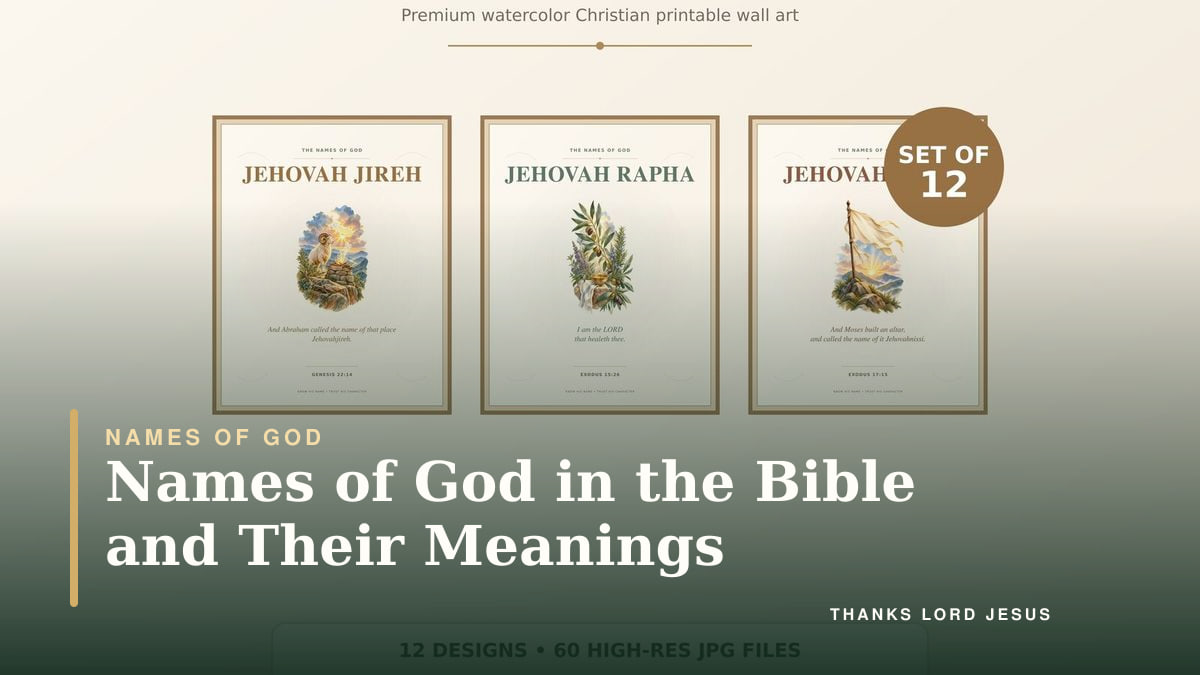
A Scripture-centered guide to important names and titles of God—what they mean, where they appear and how their biblical contexts reveal His character.

The names and titles of God in the Bible reveal who He is and how He relates to His people. Scripture calls Him Creator, Almighty, Most High, Shepherd, Provider and Peace. These are not formulas for getting a desired result. They invite us to know the one true God through His acts, covenant and ultimately Jesus Christ.
Every name belongs in its biblical context. “Jehovah-jireh,” for example, comes from Abraham’s experience on Mount Moriah in Genesis 22. “Jehovah-shalom” was the name Gideon gave an altar after God spoke peace to him in Judges 6. When we read the surrounding story, the names become more than attractive phrases: they testify to God’s character and faithfulness.
A note about LORD, Yahweh and Jehovah
In many English Bibles, LORD in small capitals represents the four Hebrew consonants YHWH. Yahweh is a widely used vocalization. Jehovah is a traditional English form and appears in several compound expressions in the King James Version.
This explains why readers may see Yahweh Jireh in one resource and Jehovah-jireh in another. They refer to the same divine name in different transliteration traditions. The KJV normally prints YHWH as LORD, but it uses forms such as Jehovah-jireh, Jehovah-nissi and Jehovah-shalom in specific verses.
The important thing is not winning a pronunciation debate. It is hearing what Scripture says about the living God whose name is holy.
1. Elohim — God, the mighty Creator
The Bible opens, “In the beginning God created the heaven and the earth” (Genesis 1:1, KJV). The Hebrew word translated God is *Elohim*. It appears throughout the Old Testament and, in Genesis 1, presents God as the sovereign Creator who speaks light, life and order into being.
The form is plural, while it is regularly joined to singular verbs for Israel’s God. Grammar alone is not a complete proof of the Trinity, though the term is consistent with Scripture’s revelation of one God and the fuller revelation of Father, Son and Holy Spirit. Elohim reminds us that creation—and our lives—depends on Him.
Key references: Genesis 1:1; Genesis 1:26–27; Psalm 19:1.
2. I AM and YHWH — the self-existent, covenant God
At the burning bush, Moses asked what he should say if Israel asked for the name of the God who sent him. God answered, “I AM THAT I AM” and then, “I AM hath sent me unto you” (Exodus 3:14, KJV). In the next verse, God identifies Himself as “the LORD God” of Abraham, Isaac and Jacob and says, “this is my name for ever” (Exodus 3:15, KJV).
The passage communicates God’s independent, enduring being and faithful presence. He is not created or sustained by anything outside Himself, yet He is not remote: He has seen Israel’s affliction and come to deliver them (Exodus 3:7–8).
Jesus’ words, “Before Abraham was, I am” (John 8:58, KJV), carry profound significance in the Gospel of John. Christian readers understand Jesus not merely as a teacher speaking about God but as the eternal Son who shares the divine identity.
Key references: Exodus 3:13–15; Exodus 6:2–3; John 8:58.
3. El Shaddai — Almighty God
When Abram was ninety-nine and still waiting for the covenant promise to unfold, the LORD appeared and said, “I am the Almighty God; walk before me, and be thou perfect” (Genesis 17:1, KJV). The Hebrew title behind “Almighty God” is *El Shaddai*.
The origin of *Shaddai* is discussed by scholars, so it is safest to stay with Scripture’s clear emphasis: God is Almighty. His power can fulfill humanly impossible promises, yet the title is not permission to demand anything we imagine. God defines the promise and calls Abram to obedience.
Knowing God as Almighty brings humility as well as confidence. We trust His ability, submit to His wisdom and refuse to reduce Him to a tool for our plans.
Key references: Genesis 17:1–8; Genesis 35:11; Psalm 91:1.
4. Jehovah-jireh — the LORD will provide
Genesis 22 tells the difficult story of Abraham being tested concerning Isaac. Before reaching the mountain, Abraham told his son, “God will provide himself a lamb” (Genesis 22:8, KJV). God stopped Abraham from harming Isaac and provided a ram for the offering. Abraham then named the place Jehovah-jireh (Genesis 22:14).
The KJV says, “In the mount of the LORD it shall be seen” (verse 14). The traditional meaning “the LORD will provide” reflects a connection between seeing and providing in the underlying language: God saw the need and supplied the sacrifice.
This name should not be reduced to a promise of effortless wealth. God’s provision is understood according to His wisdom and redemptive purpose. For Christians, the scene also points beyond the ram to God’s gift of His Son, the Lamb of God (John 1:29; Romans 8:32).
Key references: Genesis 22:8–14; John 1:29; Romans 8:32.
5. Jehovah-shalom — the LORD is peace
Gideon encountered the angel of the LORD while Israel lived under Midianite oppression. Afraid that he would die after the encounter, Gideon heard, “Peace be unto thee; fear not” (Judges 6:23, KJV). He built an altar and called it Jehovah-shalom (Judges 6:24).
This peace came before Gideon’s circumstances were resolved. God met him while conflict still lay ahead. Biblical peace is deeper than a trouble-free environment; it begins in relationship with God and gives courage for obedience.
The New Testament announces peace with God through Jesus Christ (Romans 5:1) and calls Christ “our peace” in the reconciliation of divided people (Ephesians 2:14, KJV). God’s peace moves us toward trust, obedience and peacemaking.
Key references: Judges 6:22–24; Romans 5:1; Ephesians 2:13–18.
6. The LORD who heals
At Marah, Israel found bitter water and complained. God made the water sweet and gave instruction, describing Himself as “the LORD that healeth thee” (Exodus 15:26, KJV). This phrase is often represented as Jehovah-rapha or Yahweh-rophe, “the LORD who heals.” The compound transliteration itself is not printed in the KJV verse, but the meaning is stated directly.
Scripture presents God as healer while also showing faithful people who endured illness. We can pray boldly without promising a timetable or blaming the sick for lacking faith. Every healing is mercy, and the final Christian hope is resurrection.
God’s healing work also addresses the deepest human need: sin. Christ “bare our sins in his own body on the tree” (1 Peter 2:24, KJV), bringing forgiveness and restoration to those who trust Him.
Key references: Exodus 15:22–26; Psalm 103:2–3; 1 Peter 2:24; Revelation 21:4.
7. The LORD is my Shepherd
David begins Psalm 23, “The LORD is my shepherd; I shall not want” (Psalm 23:1, KJV). A shepherd leads, feeds, protects, corrects and stays with the flock. The name is personal—my shepherd—yet never private in a selfish sense. God gathers a people who listen to His voice and follow His paths.
Jesus takes up this image: “I am the good shepherd” (John 10:11, KJV). He knows His sheep and lays down His life. Psalm 23 does not promise the absence of dark valleys, but the Shepherd’s presence and faithful guidance through them.
Key references: Psalm 23:1–6; Ezekiel 34:11–16; John 10:11–16.
How to pray with the names of God
The names of God can enrich prayer when they keep us anchored in Scripture. Rather than repeating a title as a formula, read its passage and respond to what God reveals.
- Praise Elohim for creation and offer your life to your Creator.
- Trust El Shaddai with a situation beyond your strength, while submitting to His will.
- Thank Jehovah-jireh for His wise provision and ask for daily bread.
- Receive the peace of Jehovah-shalom and seek reconciliation where possible.
- Follow the Shepherd’s voice through His Word.
The power is not in syllables. The power belongs to God. His names help us pray truthfully because they point to His character and works.
Key takeaways
- Biblical names reveal God’s character; they are not magical formulas.
- LORD, Yahweh and Jehovah reflect different conventions for representing the divine name YHWH.
- Each name should be understood within the story where Scripture gives it.
- God is Creator, Almighty, Most High, Provider, Peace, Healer and Shepherd.
- The Old Testament names find their fullest Christian focus in Jesus, who reveals the Father and brings salvation.
Choosing a Names of God print for a gift or reading corner
Start with the passage the recipient wants to revisit. Then check whether the artwork displays a divine name, an explanation of that name, or a direct Bible quotation. Those are different things. A meaningful label can point toward Scripture without being the wording of a verse.
| A passage the recipient values | A design to compare | What the product actually displays |
|---|---|---|
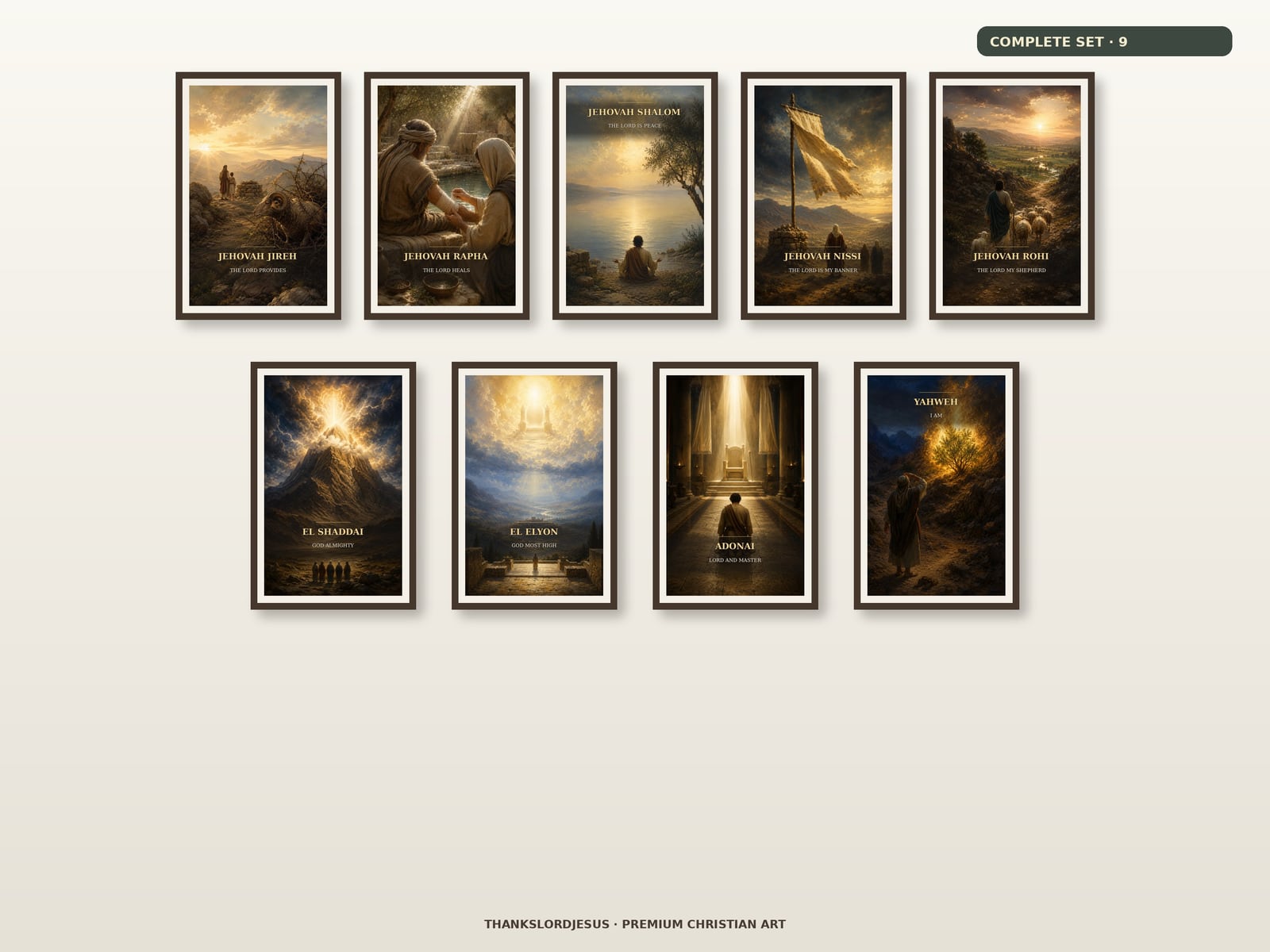
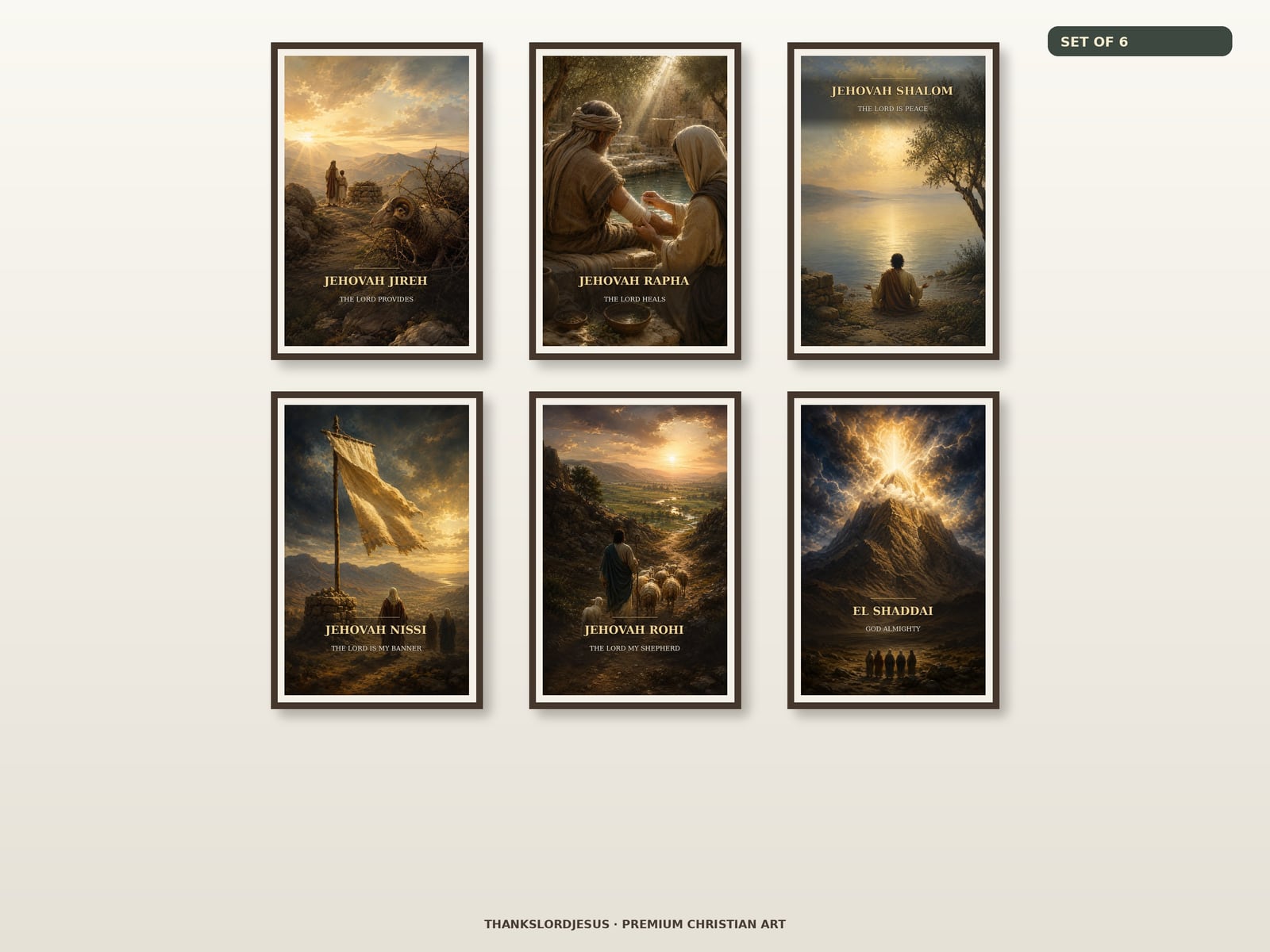
| Judges 6:22–24 and Gideon's encounter | Jehovah Shalom — The Lord Is Peace | The name and its meaning; the product description says Bible verse wording is not printed. |
| Psalm 23 and the shepherd theme | Jehovah Rohi — The Lord My Shepherd | The name and its meaning; it is not a printed copy of Psalm 23. |
The scenes are TLJ interpretations of these themes. For example, a quiet-water setting in a peace-themed painting should not be described as a literal reconstruction of Gideon's altar. The Scripture reference supplies context; the artwork supplies a visual treatment.
For a gift, ask whether the recipient prefers older biblical forms such as Jehovah or a design with familiar verse wording. If they want the whole passage visible, choose a product that actually includes it. Do not buy a name print expecting a full Psalm to appear in the download.
For a January reading-corner refresh, choose one passage to study before adding several frames. Put the print where the name is legible, keep a Bible within reach, and use a separate note for the passage reference if it is not printed on the design. Displaying a divine name is not a formula for peace, healing or provision.
Browse Names of God Scripture Art and compare the exact lettering. The printable-art buying guide helps with format choices before purchase; printing and framing are arranged separately.
Know the God behind the names
Studying biblical names should lead beyond information into worship, trust and obedience. The Creator is also the Shepherd. The Almighty speaks peace. The Most High comes near. The Provider gives not only daily bread but His Son for our salvation.
Choose one name from this guide and read its full chapter this week. Notice what God does, what He says and how people respond. If you would enjoy a quiet visual reminder as you study, you can Explore Names of God Scripture Art. May every word on the wall lead the heart back to the living Word.
Related printable Scripture art
Keep this biblical truth in view.

Frequently asked questions
Questions about this topic
What is God’s personal name in the Bible?+
The Old Testament uses the four Hebrew consonants YHWH. Most English translations represent them as LORD in small capitals. Yahweh and Jehovah are two English vocalization traditions associated with that name.
Is “I AM” a name of God?+
In Exodus 3:14, God tells Moses, “I AM THAT I AM” and “I AM hath sent me.” The statement is closely connected to the divine name in verse 15 and reveals God’s independent, enduring being and faithful presence.
Can I claim every compound name as a promise for any outcome I want?+
God’s character is always trustworthy, but His names should not be detached from their contexts or used to guarantee a preferred outcome. Prayer rests in His goodness, asks according to His will and submits to His wisdom.
Where can I find visual reminders of these names?+
Our Names of God printable collection gathers Scripture-centered designs for study corners, prayer rooms and Christian homes. Each piece is intended to invite deeper reading, not replace the Bible.
Scripture for your space