David and Goliath is not merely a story about believing in yourself; it is a story of God’s honor, covenant faith, wise preparation, courageous obedience, and the Lord’s deliverance.

The meaning of David and Goliath is larger than “face your giants.” In 1 Samuel 17, David trusts the covenant God of Israel, seeks God’s honor rather than his own fame, uses skills formed in ordinary faithfulness, and steps forward believing that “the battle is the LORD’S” (verse 47, KJV). The victory reveals that the Lord saves in ways human strength cannot secure.
Key takeaways
- Goliath’s challenge is ultimately a defiance of the living God, not only a threat to David’s self-esteem.
- David’s faith grows through remembered deliverance and daily responsibility.
- Refusing Saul’s armor is a decision about untested equipment, not a command to reject all help or training.
- The five stones show practical readiness; Scripture does not assign each stone a secret spiritual meaning.
- David runs toward the battle, yet his confidence remains in God rather than his speed or accuracy.
- The story points beyond personal success to God’s saving rule and, within the whole Bible, to the greater victory of the anointed King.
What happens in 1 Samuel 17?
Israel and the Philistines gather on opposite hills with the valley of Elah between them. A Philistine champion named Goliath comes out and proposes representative combat: one Israelite will fight him, and the losing side will serve the winner’s people. His armor, weapons, and repeated challenge create fear throughout Saul’s army.
David is not introduced in the chapter as a front-line warrior. He moves between serving Saul and tending his father’s sheep near Bethlehem. Jesse sends him with food for his brothers and provisions for their commander. When David reaches the camp, he hears Goliath’s challenge and sees the soldiers flee.
David asks why this “uncircumcised Philistine” should “defy the armies of the living God” (1 Samuel 17:26, KJV). His oldest brother accuses him of pride, but David continues asking. Saul eventually hears of him. David recounts God’s deliverance from a lion and a bear, declines Saul’s unproved armor, chooses five smooth stones, and meets Goliath with a staff, sling, and faith in the Lord.
One stone sinks into the giant’s forehead. Goliath falls, David uses Goliath’s own sword, and the Philistine army flees. The account is direct about battle and death; it does not celebrate cruelty. Its focus is public deliverance and the vindication of the God whom Goliath defied.
Seven David and Goliath lessons
Lesson 1: See the conflict in relation to God’s honor
Israel’s soldiers see an unbeatable opponent. David sees a man defying “the living God.” This does not mean every personal frustration is a holy war. It means David interprets this specific covenant conflict through the truth of who God is.
Goliath has turned the contest into a theological boast. He curses David by his gods (verse 43). David responds, “I come to thee in the name of the LORD of hosts” (verse 45, KJV). His aim is that “all the earth may know that there is a God in Israel” (verse 46, KJV). The center is God’s reputation among the nations, not David’s brand.
Before calling a difficulty “your Goliath,” ask whether the biblical analogy actually fits. Some obstacles require patience, counsel, repentance, medical help, or long obedience rather than dramatic confrontation. The faithful question is not, “How can I star in a victory story?” but, “What response honors God in this real situation?”
Lesson 2: Courage remembers God’s past faithfulness
David tells Saul that when a lion or bear took a lamb, he pursued it and rescued the sheep. “The LORD that delivered me out of the paw of the lion, and out of the paw of the bear,” he says, “he will deliver me out of the hand of this Philistine” (1 Samuel 17:37, KJV).
This is not nostalgia. Memory becomes evidence for present trust. David does not claim that past success guarantees every desired outcome. He recognizes the same faithful God in a new assignment. Christians can practice this kind of remembrance by recording answered prayer, rehearsing biblical acts of salvation, and thanking God for sustaining grace.
The Psalms repeatedly train the heart this way. Their prayers recall creation, exodus, covenant, and personal deliverance. The Psalms of Peace and Protection collection gathers several such reminders for seasons when fear feels louder than faith.
Lesson 3: Ordinary faithfulness prepares us for visible tests
David’s preparation happens away from applause. He protects sheep, learns to use a sling, carries supplies as his father directs, and asks careful questions when he reaches the camp. The celebrated moment rests on habits formed in uncelebrated work.
Faith and skill are not enemies. David trusts God and selects a weapon he can use. Christians sometimes imagine that planning shows weak faith, but Scripture regularly joins dependence on God with wise action. Prayer does not remove the need to learn, practice, verify, seek counsel, and show up prepared.
Lesson 4: Why did David refuse Saul’s armor?
Saul clothes David with his own armor, including a helmet and coat of mail. David tries to move in it and says, “I cannot go with these; for I have not proved them” (1 Samuel 17:39, KJV). The problem stated in the text is unfamiliarity. David has not tested the equipment.
The passage does not teach that armor is inherently faithless, that preparation is worldly, or that believers should reject every inherited method. Saul himself should have led with faithful courage. David simply refuses to enter a lethal contest constrained by tools he cannot use.
The wisdom is practical: do not mistake someone else’s appearance of readiness for your own readiness. Test tools before a crisis. Understand their limits. Receive good help without pretending to possess another person’s experience. For a different biblical use of armor—as a picture of truth, righteousness, faith, salvation, and God’s word—read the Armor of God in Ephesians 6 explained.
Lesson 5: What do the five smooth stones mean?
David chooses “five smooth stones out of the brook” and puts them in his shepherd’s bag (1 Samuel 17:40, KJV). The Bible does not tell us that the stones represent five virtues, five doctrines, or Goliath’s relatives. Those ideas may work as sermon illustrations, but they should not be presented as the passage’s inspired meaning.
The plain observation is already valuable. David prepares more than the single stone he eventually uses. Smooth stones suited a sling, and he selects them before approaching Goliath. Trust in God does not force David to act carelessly. He is ready to continue if the first attempt does not end the fight.
There is humility in staying with what the text reveals. We do not need hidden codes to make Scripture meaningful. Five stones show a shepherd-warrior making a sensible choice within a larger dependence on God.
Lesson 6: Faith moves toward obedient action
When Goliath advances, “David hasted, and ran toward the army to meet the Philistine” (1 Samuel 17:48, KJV). His faith is not passive agreement. He acts on what he has confessed.
Biblical courage is not the absence of every bodily feeling of fear. It is obedient action because God’s truth carries more weight than the threat. Sometimes courage looks dramatic; often it looks like telling the truth, asking forgiveness, seeking help, protecting someone vulnerable, or doing the next duty without knowing the whole outcome.
Lesson 7: “The battle is the LORD’S” does not mean “do nothing”
David declares that the Lord saves “not with sword and spear” and that “the battle is the LORD’S” (1 Samuel 17:47, KJV). Then he runs, slings, strikes, and completes the victory. Divine sovereignty and human responsibility are not competitors in the story.
The phrase means the decisive power and honor belong to God. Israel cannot explain the outcome by superior weapons. David’s activity is real, but it is not ultimate. This guards against two errors: anxious self-reliance, as if everything rests on us, and passive avoidance, as if trusting God excuses disobedience.
Is David simply a model for us—or does the story point further?
David is an example of faith, but he is also the Lord’s anointed king in the unfolding story of Samuel. Israel cannot defeat its enemy; its representative wins, and the people share the result. That pattern invites Christian readers to look toward Jesus, the greater Son of David, who defeats sin and death in a way His people could never achieve for themselves.
Applying David and Goliath without turning it into a slogan
Name the challenge honestly. Study the situation rather than exaggerating or minimizing it. Remember specific ways God has been faithful. Ask what skills, counsel, tools, or safeguards responsible action requires. Examine whether your goal is God’s honor or personal recognition. Then take the next obedient step and leave the outcome with Him.
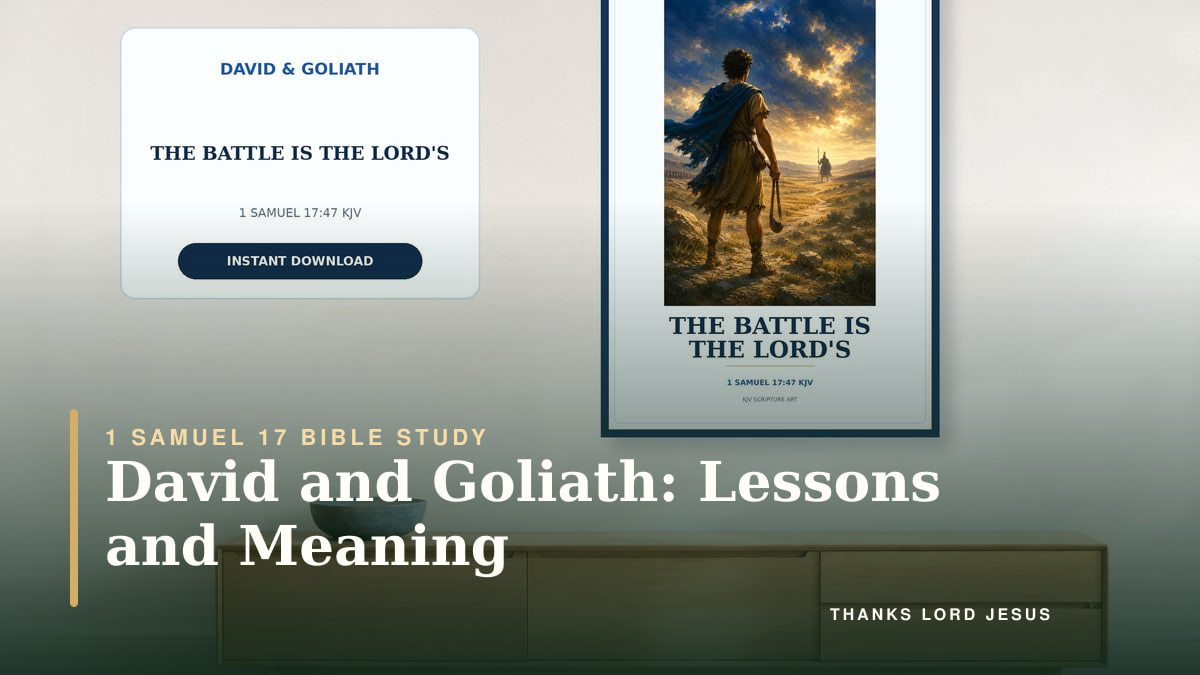
The David and Goliath Bible art collection follows the movement of 1 Samuel 17 through six non-graphic designs: the Lord’s battle, the five stones, David coming in God’s name, the giant’s fall, David running forward, and remembered deliverance. Use each reference as an invitation to reopen the chapter, not as a substitute for reading it.
David’s deepest lesson is not that small people can accomplish anything they imagine. It is that the living God is worthy of trust, His honor matters more than human intimidation, and faithful people can act courageously with the means He has given them.
Related printable Scripture art
Keep this biblical truth in view.



Frequently asked questions
Questions about this topic
What is the main message of David and Goliath?+
The main message is that the living God delivers and deserves the glory. David acts with courage and practiced skill, but he explicitly says the battle belongs to the Lord so that all the earth may know Israel’s God.
What do David’s five smooth stones symbolize?+
First Samuel 17 does not assign symbolic meanings to the individual stones. The safest reading is practical: David selected suitable ammunition for the sling he knew how to use and prepared more than one shot while trusting God for the outcome.
Why did David refuse Saul’s armor?+
David says he had not proved or tested it. The armor was unfamiliar and restricted him. The point is not that all armor or human preparation is wrong, but that David wisely used tools he had practiced with.
How old was David when he fought Goliath?+
The chapter presents David as the youngest son who tended sheep and was not serving with his three oldest brothers, but it does not state his exact age. Confident age estimates go beyond the text.
Does “the battle is the Lord’s” mean Christians should not prepare?+
No. David remembers God’s deliverance, chooses stones, uses a practiced sling, and runs toward the task. The phrase gives decisive credit to God; it does not make responsible preparation or obedient action unnecessary.
Scripture for your space