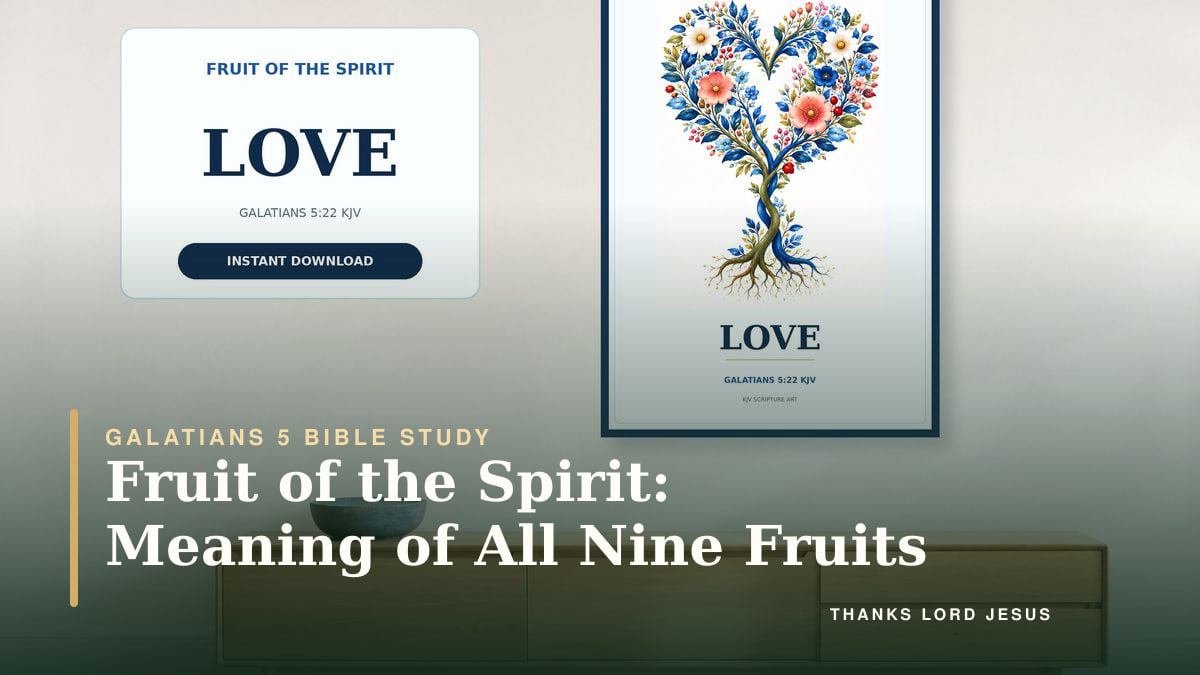
What do love, joy, peace, longsuffering, gentleness, goodness, faith, meekness and temperance mean? This guide explains all nine aspects of the fruit of the Spirit.
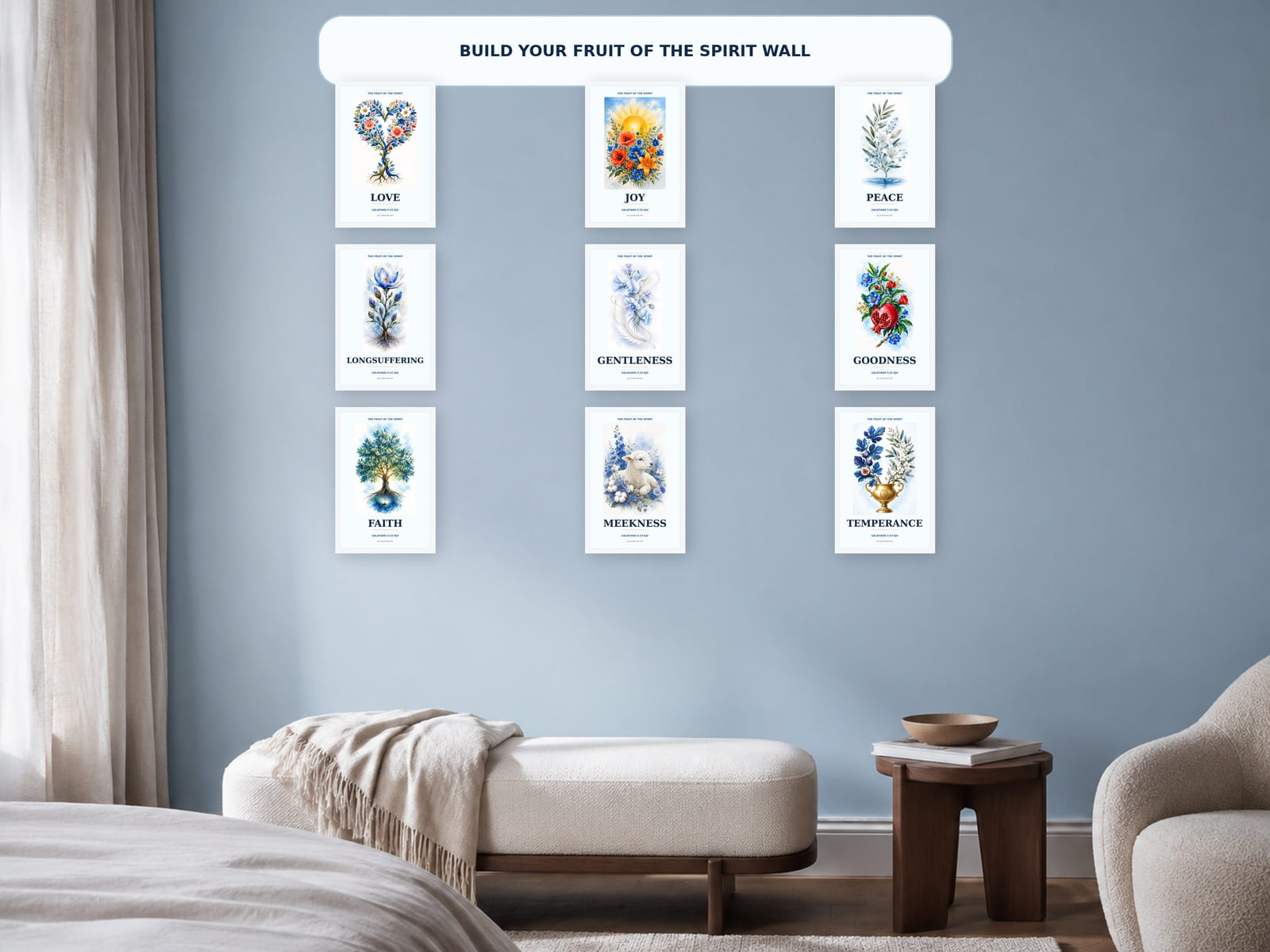
The fruit of the Spirit is the Christlike character the Holy Spirit forms in people who belong to Jesus. Galatians 5:22–23 names “love, joy, peace, longsuffering, gentleness, goodness, faith, meekness, temperance” (KJV). These qualities do not earn God’s acceptance; they reveal His transforming work.
Although people often say “the nine fruits of the Spirit,” Paul uses the singular word fruit. The nine qualities belong together as one beautiful harvest. We may notice some more strongly than others, but the Spirit’s purpose is not to make one believer loving without self-control or peaceful without faithfulness. He forms a whole life that increasingly resembles Jesus.
The context of Galatians 5:22–23
Galatians teaches justification by faith in Jesus, not by works of the law (Galatians 2:16). Christian freedom is not permission to serve selfish desires. Paul writes, “by love serve one another” (Galatians 5:13, KJV), then says, “Walk in the Spirit” (Galatians 5:16, KJV).
Paul contrasts works of the flesh that fracture lives (Galatians 5:19–21) with the Spirit’s fruit. This is not instant perfection: verse 17 acknowledges conflict between flesh and Spirit, while verse 25 calls believers to keep walking in the Spirit.
The fruit is therefore both God’s work and our daily response. We cannot manufacture spiritual life, yet we are called to remain near Christ, obey the Spirit and turn away from the desires of the flesh.
What are the nine fruits of the Spirit?
The KJV wording is love, joy, peace, longsuffering, gentleness, goodness, faith, meekness and temperance. Some modern English translations use patience, kindness, faithfulness, gentleness and self-control. These wording differences help explain older English terms, but the same nine qualities are in view.
1. Love
Love stands first because it shapes every other quality. Biblical love is more than affection. It seeks another person’s good, gives without demanding repayment and remains rooted in God’s own character. “God is love” (1 John 4:8, KJV), and believers love because He first loved them (1 John 4:19).
Jesus shows love by laying down His life (John 15:13). Spirit-produced love serves, forgives, tells the truth with grace and refuses to treat people as disposable. It does not excuse sin; love and truth belong together.
Ask: Am I seeking what honors God and genuinely benefits this person, even when it costs me comfort?
2. Joy
Joy is a deep gladness in God that can remain even when circumstances are painful. It is not forced cheerfulness, denial of grief or a command to pretend everything is fine. Jesus Himself wept (John 11:35), while the New Testament also speaks of rejoicing in the Lord.
Christian joy grows from salvation, God’s presence and hope. Paul wrote about rejoicing while imprisoned (Philippians 4:4). The Spirit places suffering within a larger story: Christ is risen, God is faithful and trouble will not have the final word.
Ask: Where can I thank God today without hiding the sorrow I also need to bring Him?
3. Peace
Peace begins with reconciliation to God through Jesus. “Being justified by faith, we have peace with God” (Romans 5:1, KJV). From that foundation, the Spirit cultivates inward steadiness and a peacemaking posture toward others.
Peace does not mean every conflict disappears. We can pray, pursue reconciliation, establish wise boundaries and entrust results to God. Romans 12:18 says, “If it be possible, as much as lieth in you, live peaceably with all men” (KJV). We cannot control another person’s response.
Ask: Am I carrying this concern to God and responding in a way that makes peace more possible?
4. Longsuffering
Longsuffering is patient endurance, especially when people or circumstances test us over time. It is slow to anger and willing to bear difficulty without giving up on obedience. God’s own patience is the source and model of ours; He is described as “slow to anger” (Psalm 103:8, KJV).
Longsuffering is not passivity toward abuse or danger; seeking safety and accountability can be right. The fruit appears as we endure delay, misunderstanding and ordinary weakness without becoming harsh or revengeful.
Ask: What would patient faithfulness look like in this situation—not for ever, but for the next right step?
5. Gentleness
In Galatians 5:22, the KJV word gentleness carries the sense often translated as kindness. It is a gracious disposition expressed in considerate action. Gentleness notices people, speaks with care and chooses mercy over needless severity.
It appears when we listen, help without seeking attention, welcome someone overlooked or correct without humiliation. Ephesians 4:32 calls believers to kindness, tenderheartedness and forgiveness.
Ask: How can my words and actions make the kindness of Christ tangible to someone today?
6. Goodness
Goodness is moral integrity that actively seeks what is right. It is closely related to kindness but includes a willingness to do good and to stand for what honors God. Spirit-produced goodness is not image management. It acts faithfully even when no one is applauding.
Goodness is not always comfortable. It includes generosity, honesty, justice, purity and courage shaped by love. Good works do not purchase salvation; believers do them as God’s workmanship, created in Christ for good works (Ephesians 2:10).
Ask: What good action is God placing in front of me that I might otherwise postpone?
7. Faith
The KJV says faith, while many translations render the word faithfulness in this list. The term can carry the idea of trust, reliability and fidelity. Here it describes a Spirit-formed life that trusts God and becomes dependable toward others.
Faith receives God’s promises; faithfulness keeps commitments. A faithful person becomes trustworthy in speech, relationships and hidden decisions. This does not mean never failing, but repenting, keeping one’s word and returning to obedience.
Ask: Is there a promise to trust, a commitment to keep or a wrong I need to make right?
8. Meekness
Meekness is strength brought under God’s control. It is not weakness, timidity or lack of conviction. Jesus describes Himself as “meek and lowly in heart” (Matthew 11:29, KJV), yet He spoke truth courageously and acted with authority.
Meekness makes us teachable, gentle in correction and willing to use strength for service. Galatians 6:1 says someone caught in a fault should be restored “in the spirit of meekness” (KJV), while the restorer watches his own vulnerability.
Ask: Can I speak truth firmly without pride, cruelty or the need to prove that I am superior?
9. Temperance
Temperance is self-control: the Spirit-enabled ability to govern desires rather than be governed by them. It affects speech, anger, appetite, sexuality, spending, entertainment, digital habits and every other area where a good desire can become a ruling demand.
Self-control is not self-salvation. The Spirit supplies power while believers practice wise limits and obedient choices. Temperance gives freedom to say yes to what is good by saying no to what enslaves.
Ask: What boundary or small act of obedience would help this desire remain in its proper place?
How does the fruit of the Spirit grow?
Fruit grows through life-giving connection, not through paint applied to a dead branch. Jesus says, “Abide in me” (John 15:4, KJV). Believers grow as they remain in fellowship with Christ through Scripture, prayer, worship, obedience and life in His body.
Practical growth may include:
- Receive grace. Remember that you are accepted through Christ, not through a perfect character score.
- Walk in the Spirit. Invite the Holy Spirit to lead ordinary choices, not only dramatic moments.
- Put away the flesh. Confess specific sin and remove patterns that repeatedly feed it.
- Practice the opposite. Replace harshness with kindness, impulsiveness with self-control and resentment with prayerful forgiveness.
- Stay in community. Mature believers can encourage growth, offer correction and help reveal blind spots.
- Be patient with the process. Real fruit often grows gradually, but gradual is not the same as optional.
The goal is not to stare constantly at the branch, but to stay close to Christ and become more loving toward God and people.
Key takeaways
- Paul speaks of one fruit with nine connected qualities.
- The fruit is produced by the Holy Spirit, not earned through human effort.
- Grace does not remove the call to obedience; believers are told to walk in the Spirit.
- Joy can coexist with sorrow, peace with conflict and longsuffering with wise boundaries.
- Growth is usually gradual and becomes visible in everyday relationships and decisions.
Choosing Fruit of the Spirit artwork: check the wording first
If a gift recipient wants the words they know from their Bible, begin with the exact artwork view. A product can be inspired by Galatians 5 without displaying the full passage, and its theme label may differ from the wording of the recipient's preferred translation.
Use the translation comparison above when checking the exact lettering: is the design quoting the passage, or displaying a theme word?
| Option | Why you might choose it | Check before purchase |
|---|---|---|
| Faith — Galatians 5:22–23 KJV printable | The recipient is looking for the KJV term “faith.” | Inspect the exact lettering and what portion of the passage is included. |
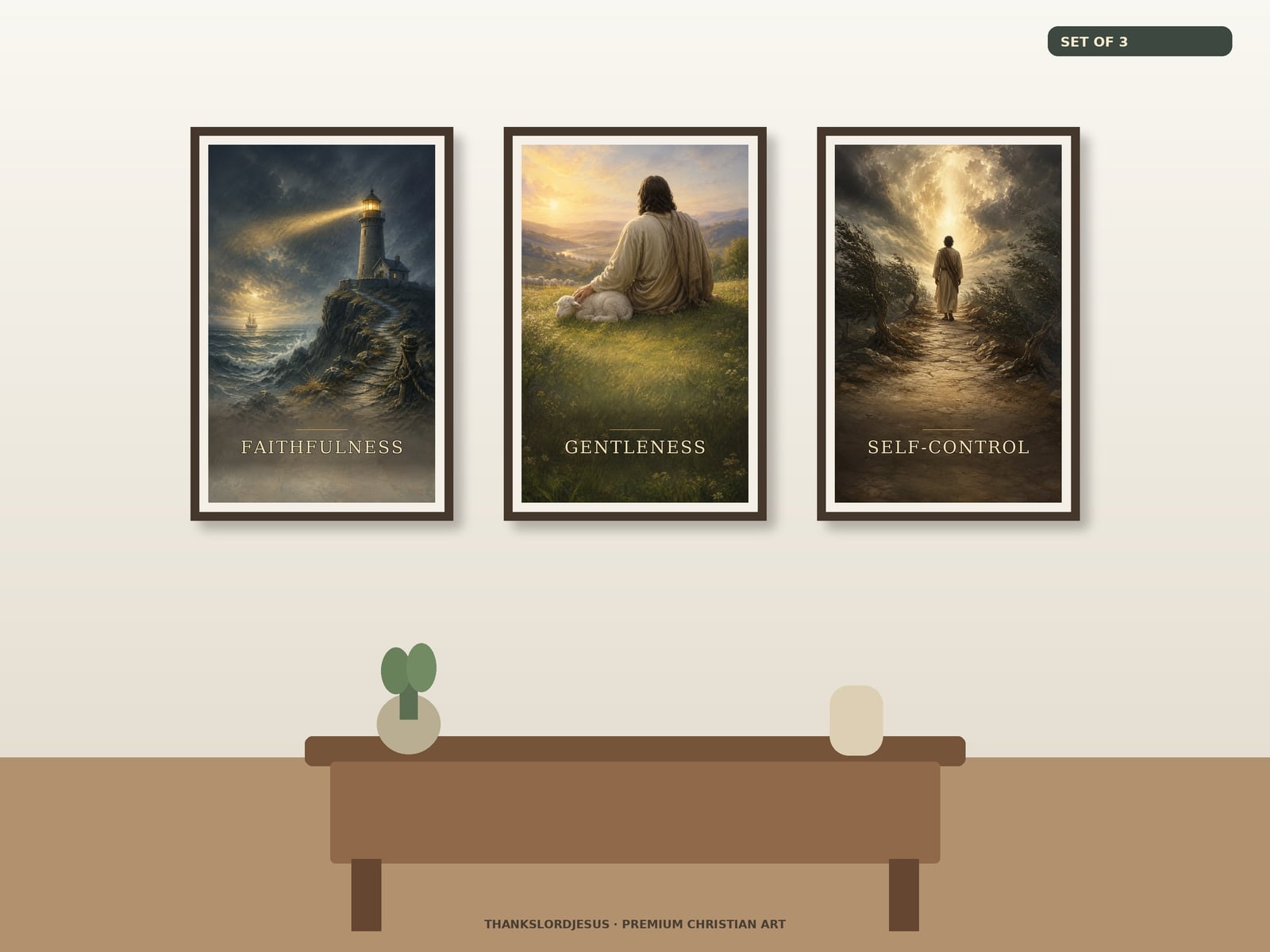
| Faithfulness — Fruit of the Spirit painting | The recipient prefers an illustrated theme word. | This design prints the fruit word; its description states that Bible verse wording is not printed. The lighthouse is an artistic symbol, not an object named in Galatians 5. |
For a family Christmas gift, choose wording the household is comfortable displaying. A themed print should invite a conversation, not function as a public report card on someone's patience or self-control. If choosing for parents, ask about their preferences before selecting art for a child's space.
The same approach works for a January home refresh: read Galatians 5:13–26, choose one design you would like to live with, and avoid treating a new frame as evidence of spiritual growth. The passage describes the Spirit's work in a life; purchasing or displaying artwork does not produce that fruit.
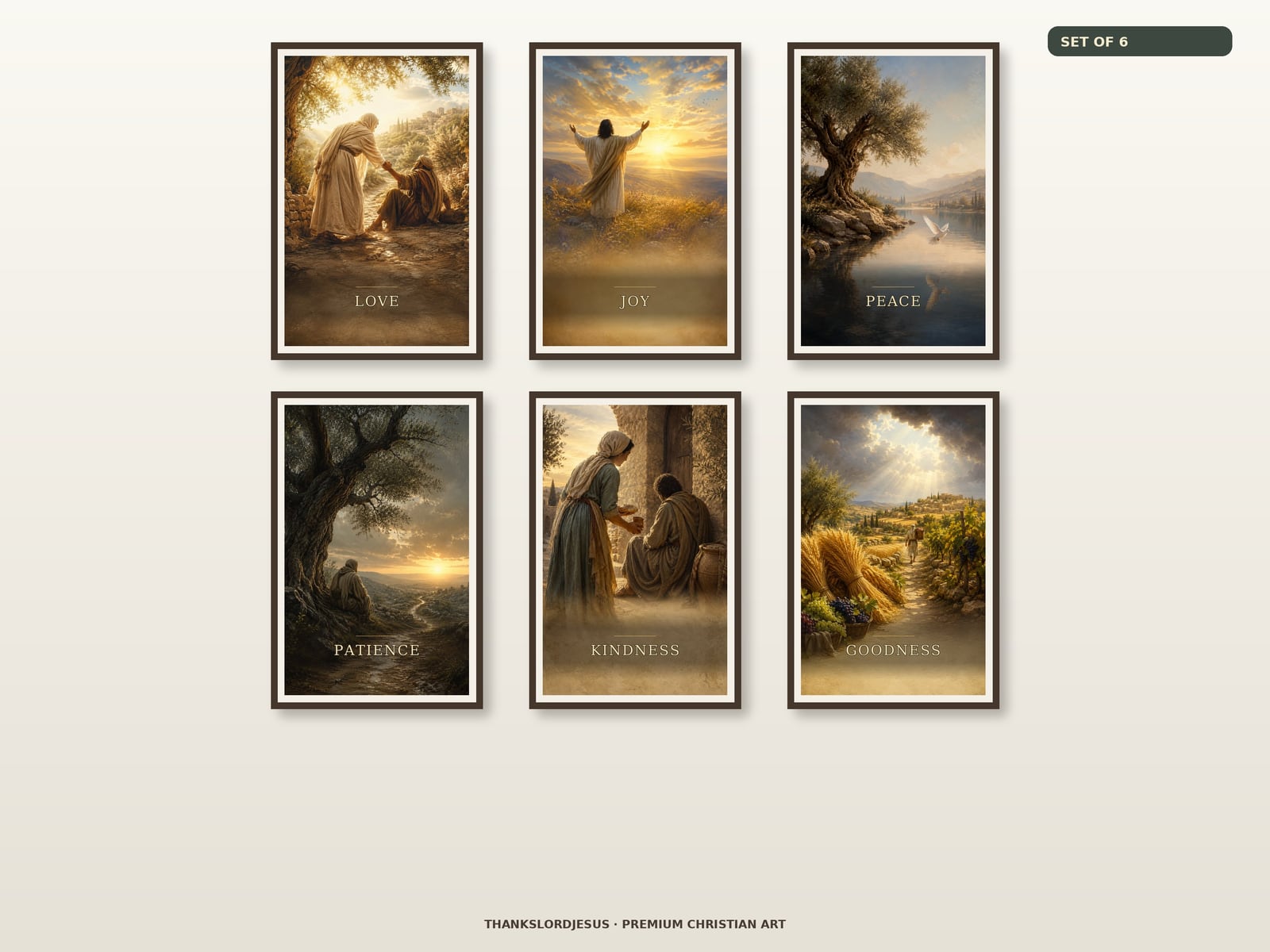
Compare the Fruit of the Spirit collection. If you are considering several designs, the existing single-print and bundle guide helps you decide whether a set fits the space and the recipient.
A life that points to Jesus
The fruit of the Spirit is not meant to make us impressive. It makes the character of Jesus increasingly visible in ordinary life: at home, online, at work, in church and in moments no one else sees. When we fail, we return to grace, repent and keep walking with the Spirit.
Read Galatians 5:13–26 slowly and ask God to highlight one relationship in which His fruit can grow. For visual reminders, visit the Explore Fruit of the Spirit Wall Art. The art supports reflection while keeping the Bible at the center.
Related printable Scripture art
Keep this biblical truth in view.

Frequently asked questions
Questions about this topic
Are there nine fruits or one fruit of the Spirit?+
Galatians 5:22 uses the singular “fruit.” Love, joy, peace and the other qualities are nine aspects of one Spirit-produced character. Saying “nine fruits” is common shorthand, but the singular reminds us that they belong together.
What is the difference between gifts and fruit of the Spirit?+
Spiritual gifts equip believers to serve in different ways (1 Corinthians 12:4–11). The fruit describes Christlike character every believer should increasingly display. A gift is not proof of maturity; gifts should be exercised with love and godly character.
Which fruit should I work on first?+
Begin with the area the Holy Spirit is bringing to your attention, but do not separate it from the rest. Pray, study relevant Scriptures and take one concrete step. Love is an especially helpful lens because it guides how every other quality is expressed.
How can children learn the fruit of the Spirit?+
Use simple definitions, Bible stories and concrete examples: sharing for love, thanking God for joy, making peace after conflict and pausing before reacting for self-control. Our Fruit of the Spirit printable collection can provide gentle visual reminders for a nursery, classroom or family devotion space.
Scripture for your space