From the dove at Jesus’ baptism to the fire and wind of Pentecost, Scripture uses vivid images to help us understand the Holy Spirit’s presence and work.
The Bible speaks plainly about the Holy Spirit, yet it also gives us memorable pictures of His presence and work. A dove descends. Wind fills a house. Fire rests upon believers. Living water flows. Each image reveals something true, but none contains the whole truth.
That distinction matters. The Holy Spirit is not an impersonal force, a bird, or a flame. He speaks, teaches, guides, can be grieved, and distributes gifts according to His will (John 14:26; Acts 13:2; Ephesians 4:30; 1 Corinthians 12:11). Christians confess Him as the divine Spirit, personally active with the Father and the Son. Biblical symbols are windows through which we see aspects of His ministry—not definitions that reduce Him to an object.
Here are seven important symbols of the Holy Spirit and the truths they help us remember.
Key takeaways
- The Holy Spirit is a divine Person, not merely a symbol or spiritual energy.
- The dove emphasizes His gracious presence and the public anointing of Jesus.
- Wind and fire point to His sovereign power, purification, and empowering presence.
- Water and oil picture life, refreshment, consecration, and God-given service.
- The seal and firstfruits emphasize belonging, assurance, and the future inheritance of believers.
- Every symbol should be interpreted in its biblical context rather than given a meaning of our own invention.
1. The dove: gracious presence and the anointing of Jesus
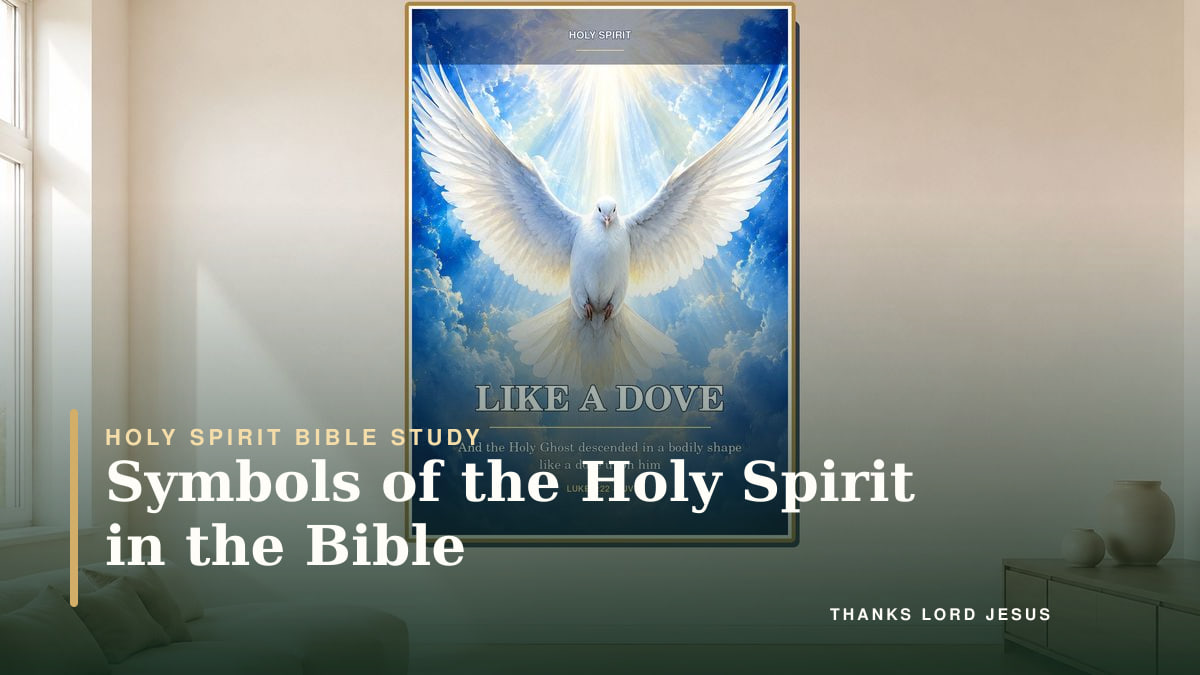
At Jesus’ baptism, John saw “the Spirit of God descending like a dove” and coming upon Him (Matthew 3:16, KJV). All four Gospels record this event, making it one of the clearest visual associations with the Holy Spirit.
Notice that the text says *like* a dove. The point is not that the Spirit is literally a dove, but that His descent was visible and dove-like. The scene publicly identifies Jesus as the beloved Son and the Spirit-anointed Messiah. It also brings Father, Son, and Holy Spirit into view together (Matthew 3:16–17).
2. Wind and breath: invisible, sovereign, life-giving power
The biblical words for *spirit* can also carry the sense of wind or breath. Jesus uses that connection in His conversation with Nicodemus: “The wind bloweth where it listeth” (John 3:8, KJV). We cannot command the wind or see it directly, but we recognize its effects. In the same way, the new birth is a work of the Spirit that cannot be manufactured by human effort.
At Pentecost, the disciples heard a sound “as of a rushing mighty wind,” filling the house where they sat (Acts 2:2, KJV). Luke carefully describes a sound like wind; he does not say an ordinary weather event swept through the room. The sign announced that God was acting powerfully and fulfilling His promise to clothe Jesus’ witnesses with power (Luke 24:49; Acts 1:8).
3. Fire: holy presence, purification, and empowerment
Fire appears throughout Scripture in connection with God’s holy presence. At Pentecost, “cloven tongues like as of fire” appeared and rested upon the believers before they were filled with the Holy Ghost (Acts 2:3–4, KJV). Again, the wording matters: these were tongues *like* fire.
The sign fits the moment. God was forming a Spirit-empowered witnessing community, and the disciples began declaring His works in languages they had not learned. The fire was not given as religious spectacle; it accompanied a mission—to bear witness to Jesus among the nations.
Fire can also suggest purification. God’s holiness exposes and consumes what is unclean, while His Spirit forms Christlike character in His people. Yet not every biblical reference to fire means exactly the same thing. Some passages use fire for judgment, others for testing, and Acts 2 for a gracious sign of God’s empowering presence. Context keeps our interpretation faithful.
4. Living water: spiritual life, satisfaction, and overflowing witness
During the Feast of Tabernacles, Jesus cried, “If any man thirst, let him come unto me, and drink” (John 7:37, KJV). John immediately explains that Jesus was speaking about the Spirit, whom believers would receive (John 7:38–39).
Water is essential to physical life, so it is a fitting image for the life only God can give. The Spirit does more than offer a temporary emotional lift. He brings the life of the age to come into believers, satisfying the deepest spiritual thirst and producing an overflow that blesses others.
5. Oil and anointing: consecration and God-given service
In the Old Testament, priests and kings were anointed with oil as they were set apart for God-given service (Exodus 30:30; 1 Samuel 16:13). When Samuel anointed David, the Spirit of the Lord came upon him. The outward oil and the inward work of the Spirit are distinct, but the scene helps explain why oil became a familiar Christian image for anointing.
Jesus is the ultimate Anointed One. He applies Isaiah’s words to Himself: “The Spirit of the Lord is upon me, because he hath anointed me” (Luke 4:18, KJV). His anointing is not self-promotion; it is consecration for good news, freedom, healing, and the fulfilment of God’s saving purpose.
The New Testament also speaks of believers receiving an anointing from the Holy One (1 John 2:20, 27). We should not turn oil into a magical substance. The symbol points beyond itself to God, who sets apart, teaches, and equips His people by the Spirit.
6. The seal: belonging, authenticity, and assurance
Paul tells believers that, after hearing and believing the gospel, they were “sealed with that holy Spirit of promise” (Ephesians 1:13, KJV). In the ancient world, a seal could mark ownership, authenticate a document, or protect what belonged to someone. The image therefore speaks of God’s claim upon His people and the trustworthiness of His promise.
Paul gives a similar encouragement in Ephesians 4:30, while also calling Christians not to grieve the Spirit. Assurance is not permission for careless living. The One who marks us as God’s own also leads us into holiness, truth, love, and unity.
7. The earnest and firstfruits: a present taste of future glory
The Holy Spirit is called the “earnest of our inheritance” (Ephesians 1:14, KJV). An earnest is a pledge or first installment that guarantees what will follow. Paul also speaks of “the firstfruits of the Spirit” as believers wait for the redemption of the body (Romans 8:23, KJV).
These images hold together the *already* and the *not yet* of Christian hope. Believers truly know God now. The Spirit truly dwells within them, forms Christ in them, helps them pray, and gives gifts for service. Yet suffering, weakness, and death have not disappeared. We still await resurrection and the full renewal God has promised.
How to use Holy Spirit symbols thoughtfully
Three simple questions help keep the imagery grounded:
- Where does this symbol appear in Scripture? Begin with the passage, not an assumed meaning.
- What does the context emphasize? The same image can function differently in different passages.
- How does it direct us to God’s work in Christ? The Spirit glorifies Jesus rather than drawing attention to spiritual novelty for its own sake (John 16:14).
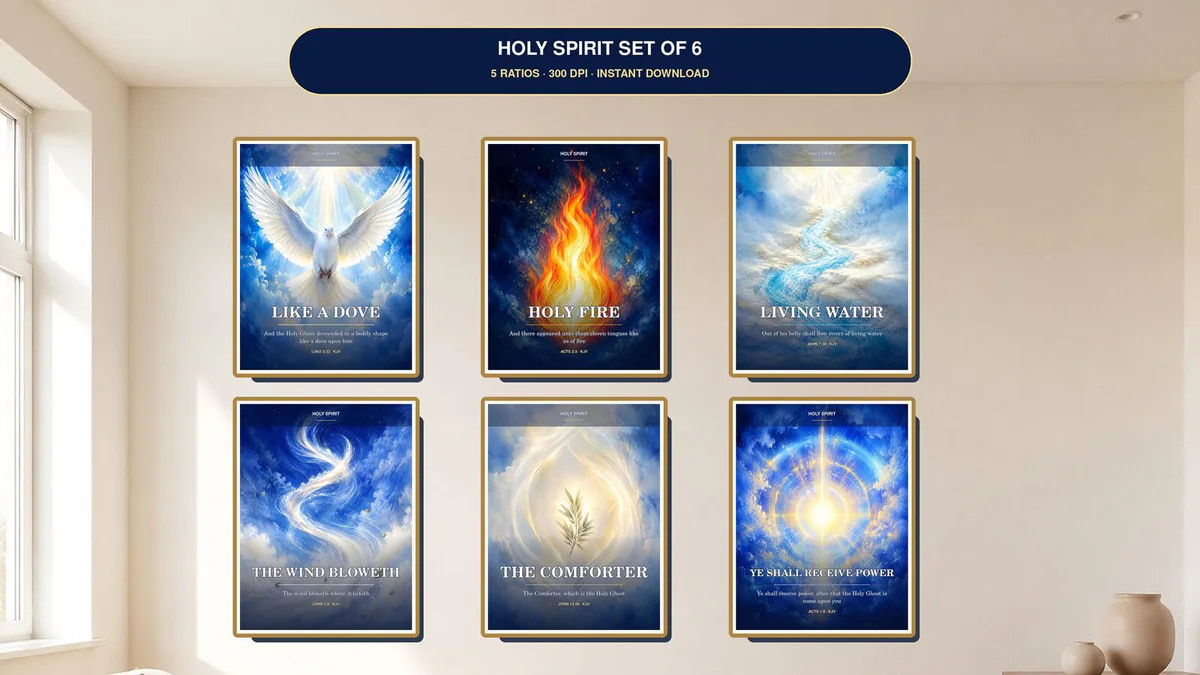
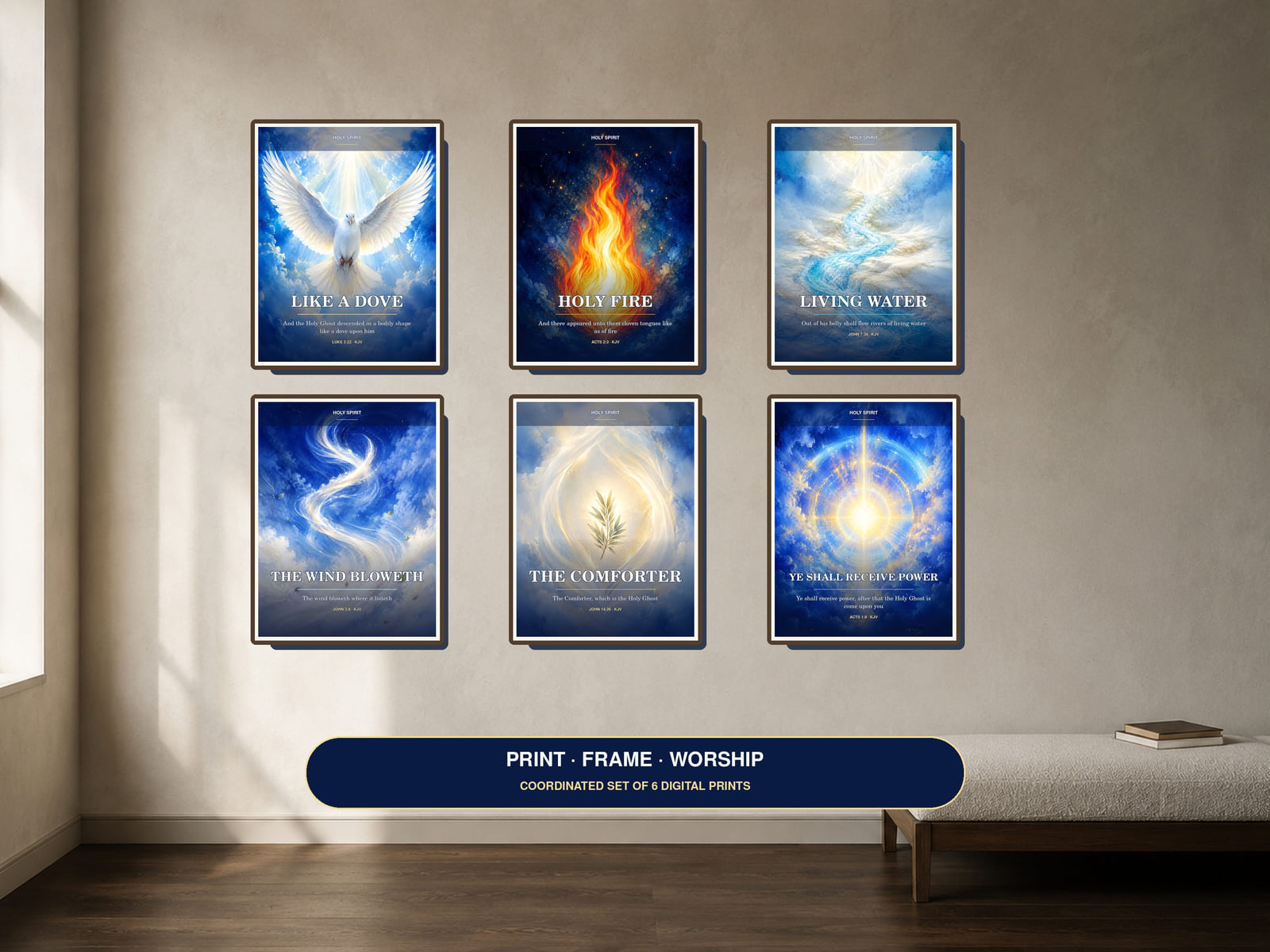
For gentle, Scripture-centered artwork inspired by these biblical images, explore our Holy Spirit printable art collection. Each design is prepared to help keep God’s Word visible in prayer spaces, family rooms, and quiet corners of the home.
Keep the truth in view
The dove, fire, wind, water, oil, seal, and firstfruits do not compete with one another. Together they show how rich the Bible’s witness is: the Spirit comes graciously, acts sovereignly, gives life, makes holy, equips for service, marks God’s people, and guarantees their future.
If you would like a printable reminder for your home or a meaningful Christian gift, Explore Holy Spirit Printable Art. Browse slowly, read the accompanying Scriptures, and choose the design that will best serve your space and your season of faith.
Related printable Scripture art
Keep this biblical truth in view.



Frequently asked questions
Questions about this topic
Is the Holy Spirit literally a dove?+
No. At Jesus’ baptism, the Spirit descended *like* a dove (Matthew 3:16). The dove is a visible biblical image associated with that event, while the Holy Spirit is the divine Person who teaches, speaks, guides, and can be grieved.
What do fire and wind mean at Pentecost?+
Acts 2 describes a sound like rushing wind and tongues like fire. Together they signal God’s powerful presence and the promised empowering of Jesus’ witnesses. The disciples’ Spirit-enabled proclamation to many nations is central to the passage.
Is oil always a symbol of the Holy Spirit?+
No. Oil has several ordinary and ceremonial uses in Scripture. It can be associated with consecration and anointing, and some anointing passages explicitly mention the Spirit. We should let each passage’s context determine its meaning.
What does it mean to be sealed with the Holy Spirit?+
Ephesians 1:13–14 connects the seal with hearing the gospel, believing in Christ, belonging to God, and receiving the promised Spirit as the guarantee of the believer’s inheritance.
Can Christian art help teach these symbols?+
Yes, when the art supports rather than substitutes for Scripture. A thoughtfully paired verse and biblical image can begin meaningful conversations and help adults and children remember what they have read.
Scripture for your space