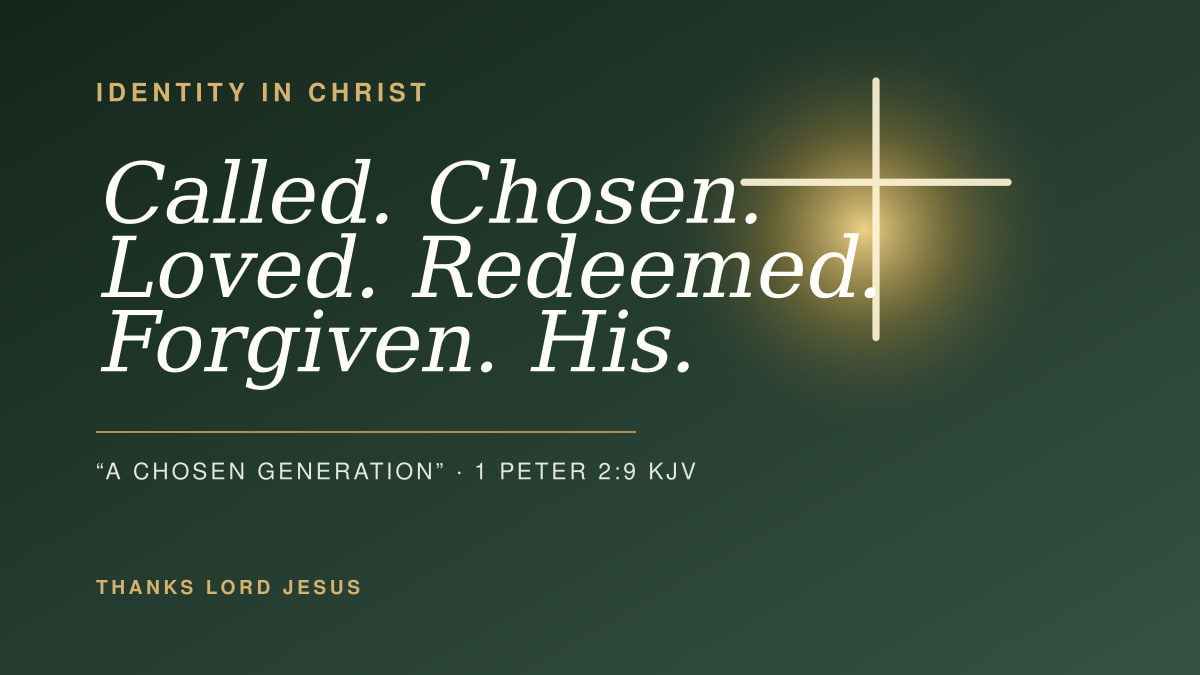
Your identity in Christ is not a motivational label. It is the new reality God gives by grace to those united to Jesus through faith.

The world offers many answers to the question, “Who am I?” We may define ourselves by success, failure, appearance, relationships, work, nationality, wounds, or the approval of other people. Some of those things are meaningful parts of our story. None is strong enough to carry the full weight of our identity.
The New Testament repeatedly uses the phrase *in Christ* to describe those who have received Jesus through faith. Christian identity is therefore not a collection of positive statements we invent about ourselves. It is a gift rooted in union with the crucified and risen Lord.
To know who we are in Christ, we begin with who He is and what He has done. We were sinners in need of mercy, not hidden heroes waiting to discover our own greatness. By grace, God forgives, reconciles, adopts, renews, and calls His people into a new way of life. Identity in Christ produces humility and assurance at the same time: we contributed no merit to our salvation, yet God’s love and promise are more secure than human approval.
Key takeaways
- Identity in Christ is received by grace through faith, not achieved through performance.
- Believers are forgiven, reconciled, adopted, made new, and brought into God’s people.
- Biblical identity is both personal and communal: Christians belong to Christ and to His body.
- Assurance does not excuse sin; grace teaches us to live in holiness, love, and good works.
- Feelings can fluctuate, but God’s promises give believers a stable place to stand.
- “In Christ” statements should be read in context, not used as slogans detached from the gospel.
You are forgiven and redeemed
One of the first truths a Christian needs to remember is that forgiveness rests on Christ’s work, not on our ability to punish ourselves long enough. Ephesians 1:7 says, “In whom we have redemption through his blood, the forgiveness of sins” (KJV).
Redemption speaks of costly liberation. Forgiveness does not mean God pretends sin is harmless. At the cross, Jesus bears judgment and makes peace through His blood. Those who are in Him do not have to create a cleaner past before coming to God. They confess their sin and rely on a sufficient Savior.
Remember: In Christ, your worst sin is not stronger than His redeeming blood. Grace does not call evil good; it brings the guilty into forgiveness and transformation.
You are no longer condemned
Romans 8 begins with one of Scripture’s clearest declarations: “There is therefore now no condemnation to them which are in Christ Jesus” (Romans 8:1, KJV).
Condemnation is a courtroom word. Paul is not saying believers never feel regret, experience discipline, or need correction. He is saying the guilty verdict has been answered in Christ. The law of the Spirit of life has set believers free, because God did what human weakness could not do (Romans 8:2–4).
Remember: When shame says, “Hide from God,” Romans 8 invites you to come through Christ and walk according to the Spirit.
You are a new creation
“If any man be in Christ, he is a new creature,” Paul writes in 2 Corinthians 5:17 (KJV). The surrounding passage is about God reconciling people to Himself through Christ and giving them a ministry of reconciliation.
New creation does not mean a believer instantly forgets the past, loses every temptation, or develops a flawless personality. It means God has acted decisively. The old order defined by separation from Him no longer has the final word. A new life has begun, and the Spirit continues to transform the believer into Christ’s likeness.
Remember: You are not trapped in the claim that nothing can ever change. In Christ, the work of new creation has begun.
You are a child of God
John 1:12 says that those who receive Christ and believe on His name are given power—or the right—to become the sons of God. Adoption is not a general statement that every human being automatically enjoys the same saving relationship with God. It is a gospel gift received through Christ.
Romans 8 develops this gift beautifully. Believers receive the Spirit of adoption and cry, “Abba, Father” (Romans 8:15). They are heirs with Christ, even as they share in present suffering and await future glory.
Remember: In Christ, you do not approach God as an unwanted stranger trying to earn a place at the table. By grace, you come as an adopted child.
You are chosen and part of God’s people
First Peter 2:9 calls believers “a chosen generation, a royal priesthood, an holy nation, a peculiar people” (KJV). The next words explain the purpose: that they should declare the praises of the One who called them from darkness into light.
This verse is often printed in the singular, but Peter speaks to the church as a people. Christian identity is personal, never private. God joins believers to a spiritual house, with Christ as the chief cornerstone (1 Peter 2:4–10).
Remember: You have been brought into a people whose purpose is to display God’s mercy and proclaim His excellencies.
You are God’s workmanship, created for good works
Ephesians 2:10 says, “For we are his workmanship, created in Christ Jesus unto good works” (KJV). This follows Paul’s famous teaching that salvation is by grace through faith and “not of works” (Ephesians 2:8–9, KJV).
The order matters. Good works are not the price of salvation; they are its fruit. We do not serve in order to persuade God to save us. God saves by grace and then forms a life that reflects His generosity, justice, truth, and love.
Remember: Your life has God-given purpose, and that purpose grows out of grace rather than anxious self-justification.
You are secure in God’s love
Romans 8 ends with a triumphant assurance that neither death nor life, present nor future, height nor depth, nor any other created thing can separate believers from “the love of God, which is in Christ Jesus our Lord” (Romans 8:39, KJV).
This promise is not based on a trouble-free life. The same passage speaks of tribulation, distress, persecution, famine, nakedness, peril, and sword. Security in Christ does not mean hardship cannot reach us; it means hardship cannot sever the covenant love of God.
Remember: Your hold may feel weak, but salvation ultimately rests in the faithful love of God revealed in Christ.
How to remember your identity when feelings disagree
Start with one passage rather than a long list of isolated phrases. Read it in context, write down what it says about God, and then note what is true of those who are in Christ. Turn the truth into prayer.
For example:
- Read: Ephesians 1:3–14.
- Observe: The passage repeatedly centers blessings “in Christ.”
- Remember: Redemption, forgiveness, adoption, and the Spirit’s seal are God’s gifts.
- Pray: Thank God specifically and ask for a life that reflects His grace.
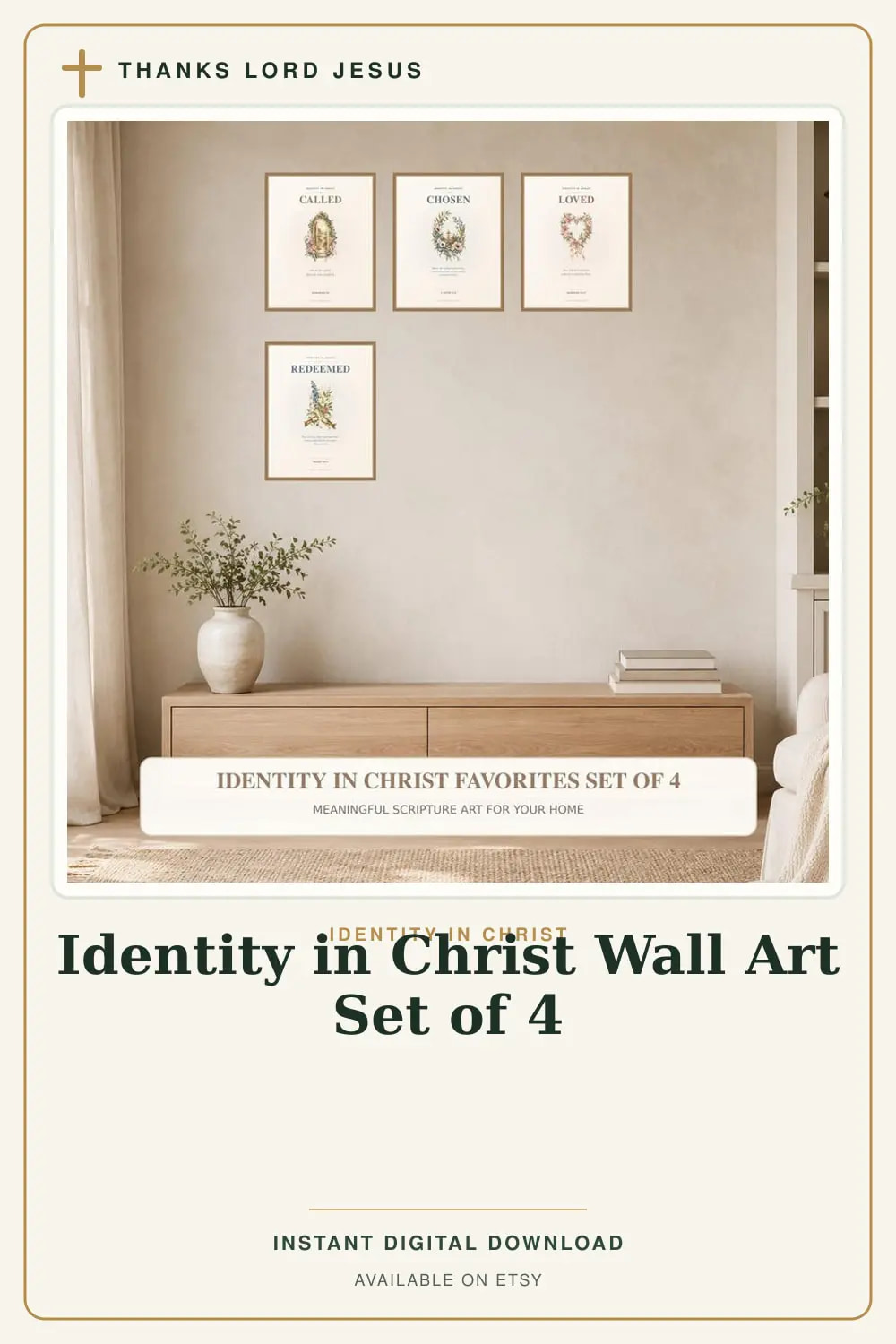
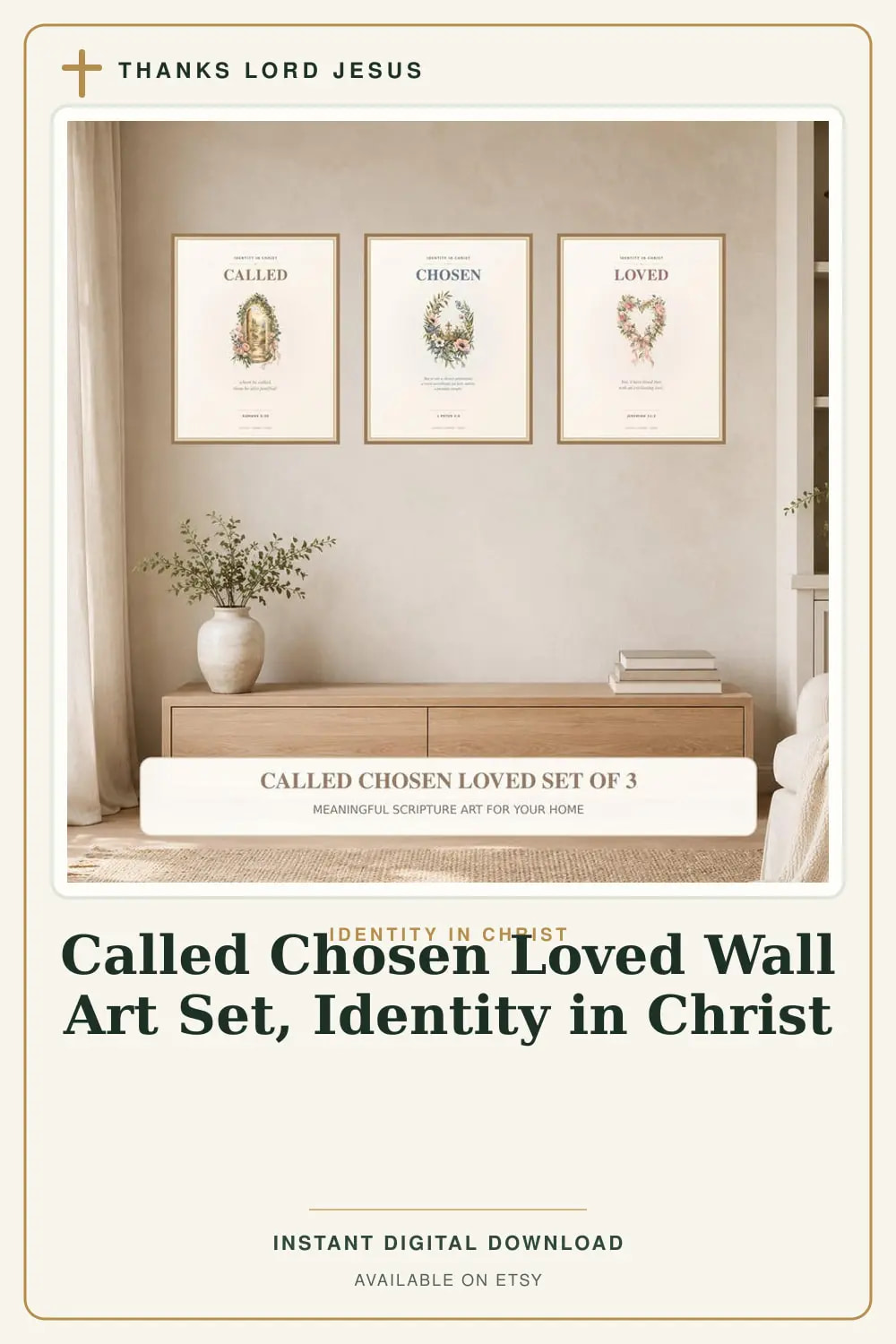
Our Identity in Christ printable collection brings together words such as *chosen*, *redeemed*, *called*, and *beloved* with their Bible references. Use the artwork as a doorway back into the passages—not as a replacement for them.
Choosing Scripture art as an encouragement gift
An encouragement gift works best when it reflects something the recipient welcomes. Before choosing a verse for someone in a difficult season, ask whether they would enjoy Scripture art and whether there is a passage they already find meaningful. Their answer is more useful than guessing from their age or choosing the strongest-sounding slogan.
| Starting point | Product to examine | Context to keep with the gift |
|---|---|---|
| The recipient values belonging to God's people | Chosen, 1 Peter 2:9 | Read 1 Peter 2:9–12: the passage speaks of a people called to declare God's praise and live faithfully. |
| Isaiah 43 is a passage they already treasure | Redeemed, Isaiah 43:1 | Read Isaiah 43:1–7, addressed to Jacob/Israel; do not turn its language into a personal prediction about the recipient's circumstances. |
| They have specifically mentioned Romans 8 | All Things Work Together, Romans 8:28 | Read verses 28–30 together. The passage connects God's purpose with conformity to His Son, not a promise that every event will feel good. |
The Identity in Christ collection brings these options together. Open each exact artwork before deciding: the title tells you the theme, while the gallery shows the wording and composition the recipient will see.
Keep the accompanying note personal and modest: “You mentioned this passage, and I thought you might like it for your reading corner.” Avoid using the gift to explain another person's loss, correct their feelings or promise recovery. A print can serve as a Scripture reminder; it cannot guarantee emotional relief or change the recipient's circumstances.
For Christmas, an anniversary or an ordinary visit, one welcomed print is enough. Confirm the intended display space and use the size guide before choosing a frame. TLJ artwork is delivered digitally; a physical print and frame are not included in the purchase.
Let the gospel name you
Achievements can disappear. Other people’s opinions can change in a day. Even our own self-evaluation moves between pride and discouragement. The gospel gives a steadier word.
In Christ, believers are redeemed, forgiven, no longer condemned, made new, adopted, joined to God’s people, shaped for good works, and held in inseparable love. These truths do not make us the center of the story. They free us to worship the One who saved us and to love others without constantly proving ourselves.
For visible reminders grounded in Scripture, Explore Identity in Christ Prints. Choose a design, open the referenced passage, and let God’s Word—not fear, failure, or applause—have the final say.
Related printable Scripture art
Keep this biblical truth in view.

Frequently asked questions
Questions about this topic
What does “in Christ” mean?+
It describes the believer’s saving union with Jesus. Through faith, Christians belong to Him and share in the benefits of His death and resurrection: forgiveness, reconciliation, adoption, new life, the Spirit’s presence, and future resurrection.
Is everyone automatically a child of God?+
Every human being bears God’s image and deserves dignity. The New Testament uses adoption and the saving status of God’s children specifically for those who receive Christ through faith (John 1:12–13; Galatians 3:26).
What if I do not feel like a new creation?+
Feelings are real but not infallible. Return to Christ’s promise, confess known sin, remain in Scripture and prayer, and seek support in a faithful church. New creation is a decisive reality that also unfolds through lifelong transformation.
Does “no condemnation” mean my choices no longer matter?+
No. Romans 8 joins freedom from condemnation with life in the Spirit. Grace removes the guilty verdict in Christ and begins a life of holy obedience; it never makes sin harmless.
How can I teach children about identity in Christ?+
Begin with the gospel: God made us, sin separates us from Him, Jesus died and rose to save, and those who trust Him are forgiven and welcomed into God’s family. Use short verses, explain them in context, and model repentance, prayer, church community, and grace.
Scripture for your space